Updated October 2026: rewritten with Eventbrite's current ratings on G2, Capterra and Trustpilot, its fees and its payout rules, all checked on October 9, 2026.
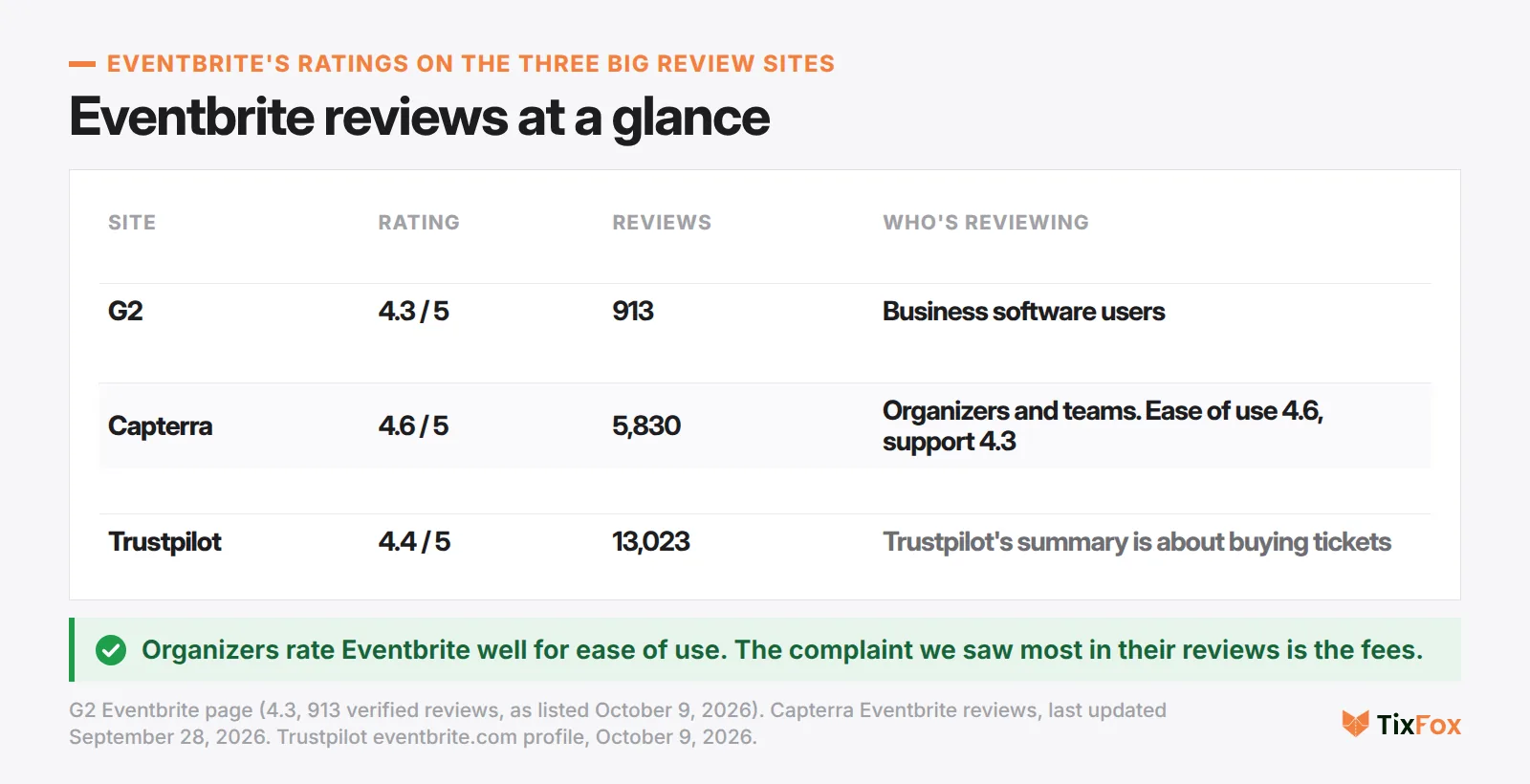
Eventbrite's ratings are strong: 4.6 out of 5 from 5,830 reviews on Capterra, 4.3 from 913 on G2 and 4.4 from 13,023 on Trustpilot. In the organizer reviews we read, though, the complaint that comes up most is the fees.
This review covers what organizers care about most: what they praise, what Eventbrite takes from each ticket, when you get paid, and when it's worth it. Fees and payout rules come from Eventbrite's own pricing and help pages.
What Eventbrite reviews say, in short
- Ratings: 4.6 on Capterra (5,830 reviews), 4.3 on G2 (913) and 4.4 on Trustpilot (13,023)
- Most praised: quick setup, a checkout buyers already trust, and Eventbrite's marketplace, which it says reaches 89 million people a month
- Complaint we saw most: fees, which on a $25 ticket come to $3.52 when buyers pay them
- Also mentioned: support that some reviewers find hard to reach, and event pages that are hard to brand
- Payouts: a first paid event on Eventbrite pays out only after it ends
Where Eventbrite earns its ratings
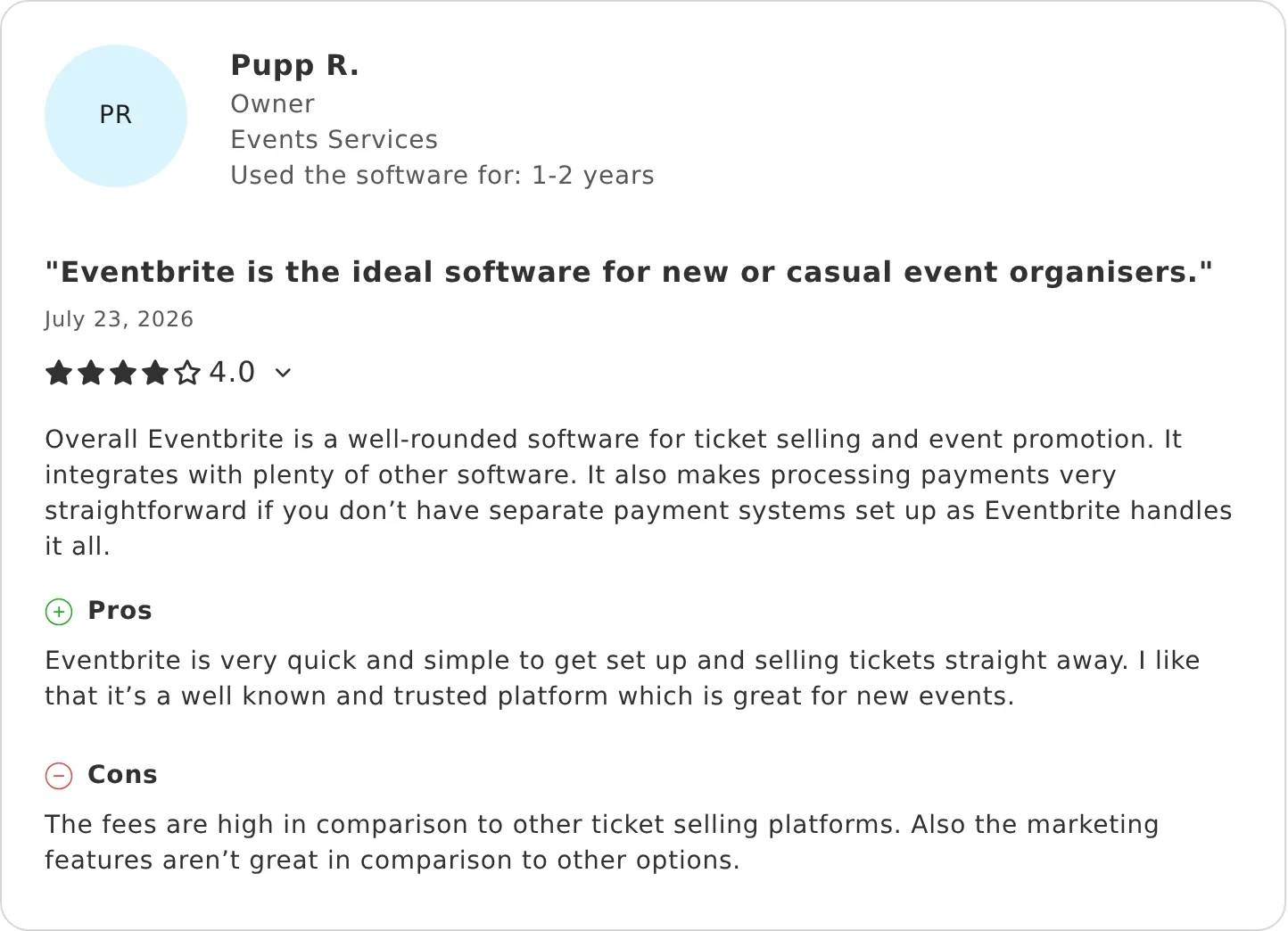
Setup speed comes up in review after review. One events business owner, Pupp R., wrote on Capterra in July 2026 that "Eventbrite is very quick and simple to get set up and selling tickets straight away," and that it's "a well known and trusted platform which is great for new events."
The second strength is reach. Eventbrite lists your event on its marketplace, which it says reaches 89 million monthly users, and offers Eventbrite Ads, email campaigns and Facebook, Instagram and TikTok promotion tools. If you're starting in a new city with no mailing list, that reach can help.
The day-to-day tools get good marks too. Furkan A., a founder who has used Eventbrite for more than two years, wrote in August 2026 that "Payments and ticket confirmations work smoothly, and the automated emails reduce a lot of manual follow-up."
What organizers complain about
Fees come first. Even happy reviewers bring them up. Furkan's five-star review adds that "The fees can become noticeable for paid events, especially as ticket volume increases." Kate W., an office manager at a sports organization, put it this way: "As with everything when you are a small business fees can add up, especially for paid events, and some customization options are limited."
Pupp R.'s review sums it up. Eventbrite was the right place to start, until the fees outgrew it:
Support comes up too. Capterra reviewers score Eventbrite's customer service 4.3, below its 4.6 for ease of use, and a September 2026 review from a ticket buyer says "It often feels difficult to reach a real person." The last theme is design: organizers mention event pages that are hard to make look like their own brand.
Trustpilot's 4.4 needs one caveat: Trustpilot's own summary of its reviews is about how easy it is to find and book tickets. For what Eventbrite is like to run events on, Capterra and G2 are the better read.
How much does Eventbrite take from ticket sales?
Eventbrite charges a service fee of 3.7% + $1.79 per ticket, plus 2.9% for payment processing on the whole order, in the US. Buyers pay the fees by default, or you can absorb them. On a $25 ticket that's $3.52 when buyers pay, or $3.45 taken from your ticket price when you absorb it. Free events are free.
The processing fee is worked out on the total order, which includes the service fee when your buyers pay it. That's why the same ticket costs a little more in fees when the fees are passed on. Here's what buyers pay on top of a single ticket, against TixFox's 39¢ plus Stripe's 2.9% + 30¢:
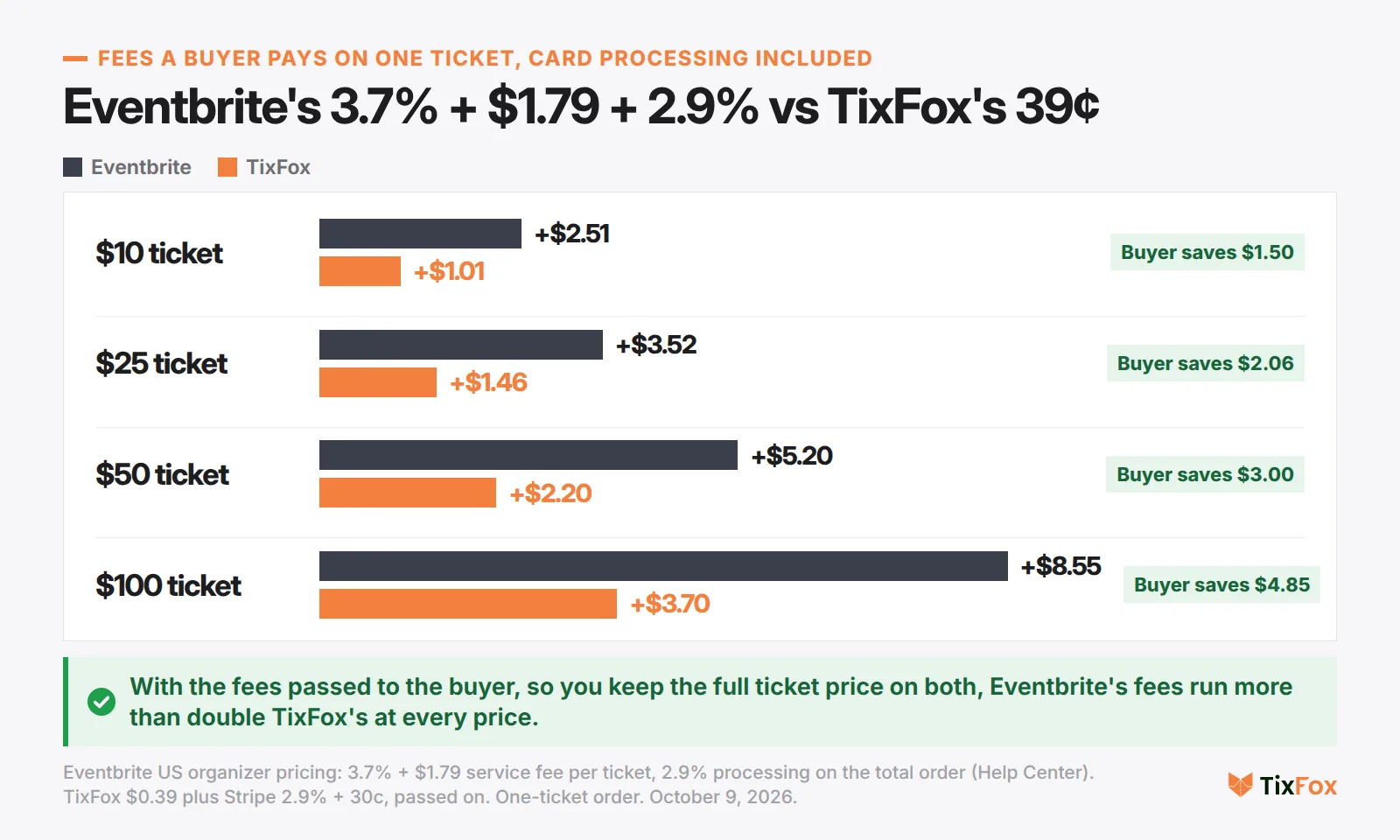
- $10 ticket: $2.51 on Eventbrite, $1.01 on TixFox
- $25 ticket: $3.52 against $1.46
- $50 ticket: $5.20 against $2.20
- $100 ticket: $8.55 against $3.70
Eventbrite's fees outside the US are different, and its Ticketing Fees page lists them country by country.
What percentage does Eventbrite take?
It depends on the ticket price, because the flat $1.79 weighs more on a cheap ticket. With the fees absorbed, Eventbrite takes 24.5% of a $10 ticket, 13.8% of a $25 ticket, 10.2% of a $50 ticket and 8.4% of a $100 ticket, card processing included.
If most of your tickets cost $10 to $30, you're paying the steepest part of that range.
What fees add up to on a 200-ticket show
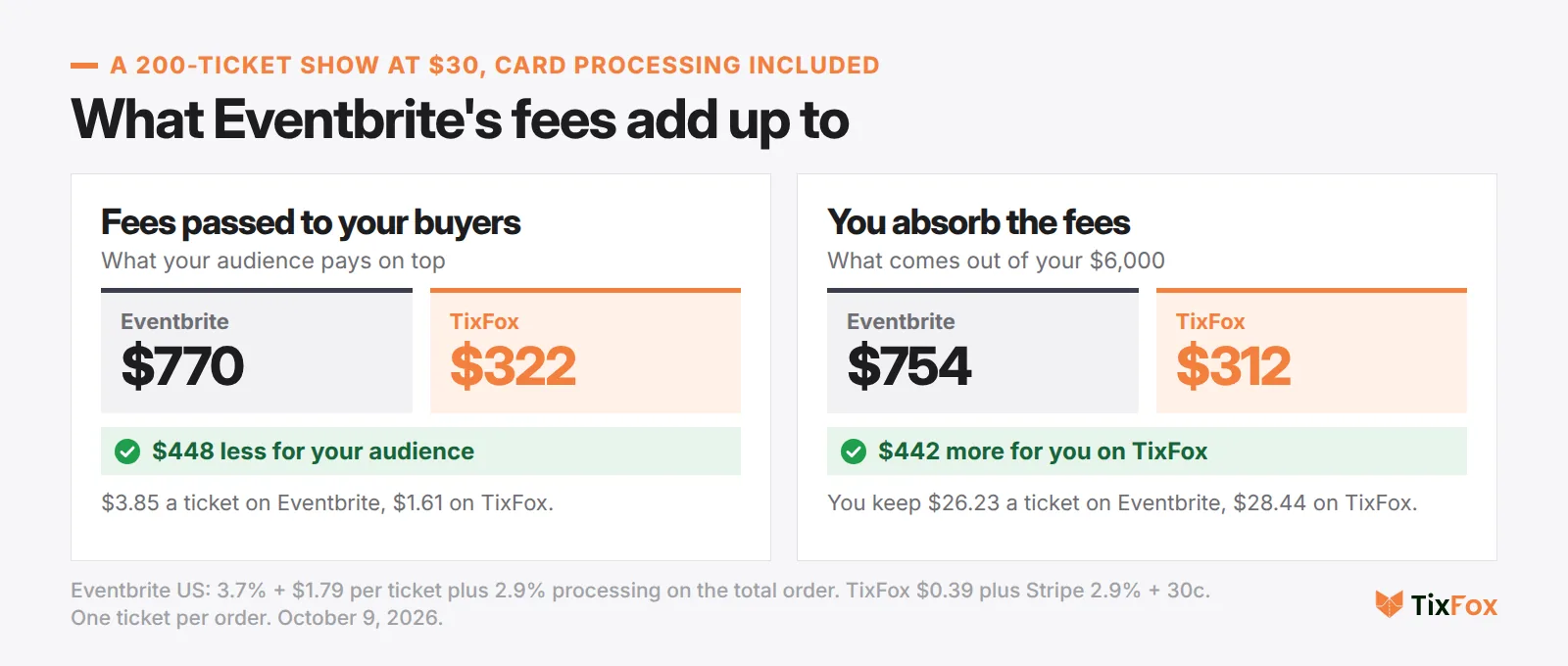
Say you sell 200 tickets at $30, one per order. If your buyers pay the fees, they'll pay $770 on Eventbrite and $322 on TixFox. If you absorb them, $754 comes out of your $6,000 on Eventbrite and $312 on TixFox, so you keep $442 more on TixFox.
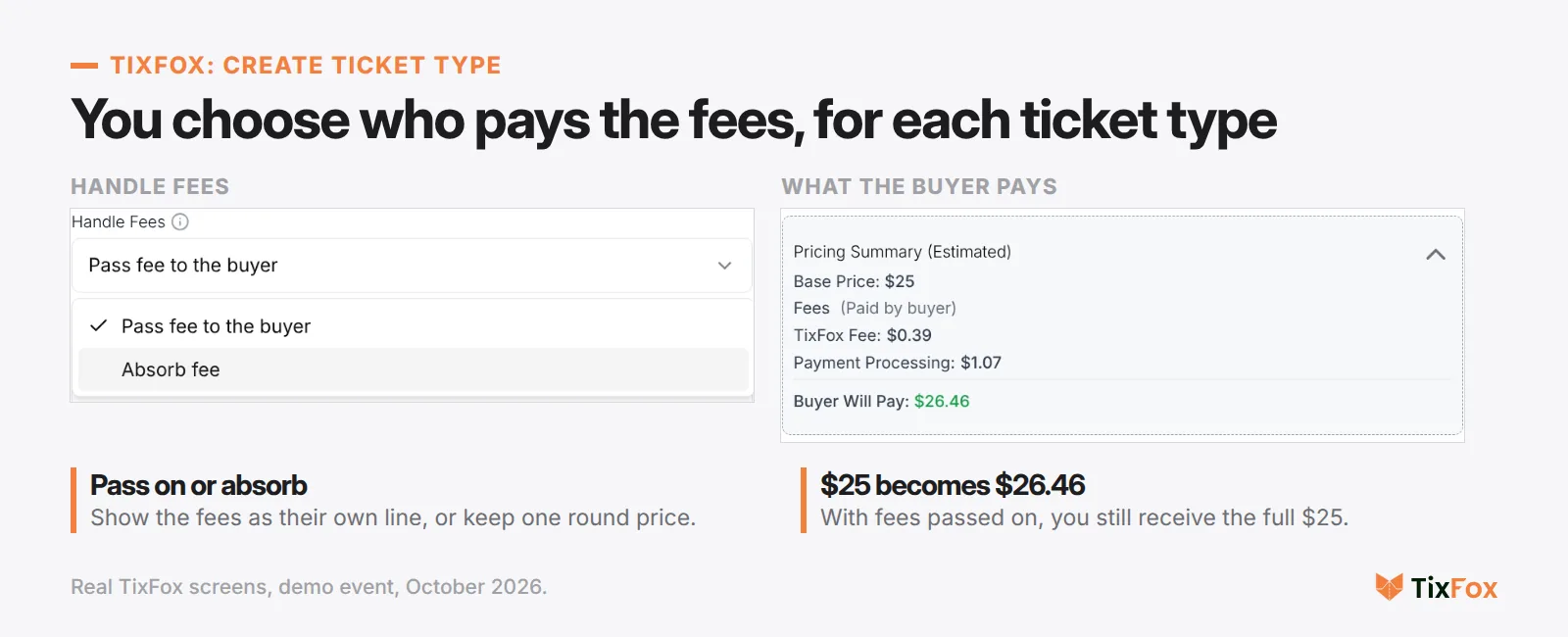
On TixFox, you choose who pays the fee for each ticket type, and the screen shows what your buyer will pay before you publish.
Selling 200 tickets at $30? On TixFox your buyers would pay $448 less in fees, or you'd keep $442 more. Create a free account and see the numbers for your own event. No credit card needed.
When does Eventbrite pay organizers?
By default, Eventbrite sends your payout three business days after your event ends, and a US bank takes another 2 to 3 business days to post it. If it's your first paid event on Eventbrite, that's your only option. Weekly, twice-monthly and instant payouts open up only after you've hosted a paid event.
Even then, there are limits. On payouts before the event, Eventbrite holds 20% of each event's net sales in reserve and caps pre-event payouts at $100,000 across your events. Instant Payouts reach your bank in about 30 minutes, but they're for some US organizers only and cost 3% of each payout, with a $2.99 minimum and a $40 maximum. Taking $500 out early costs $15.
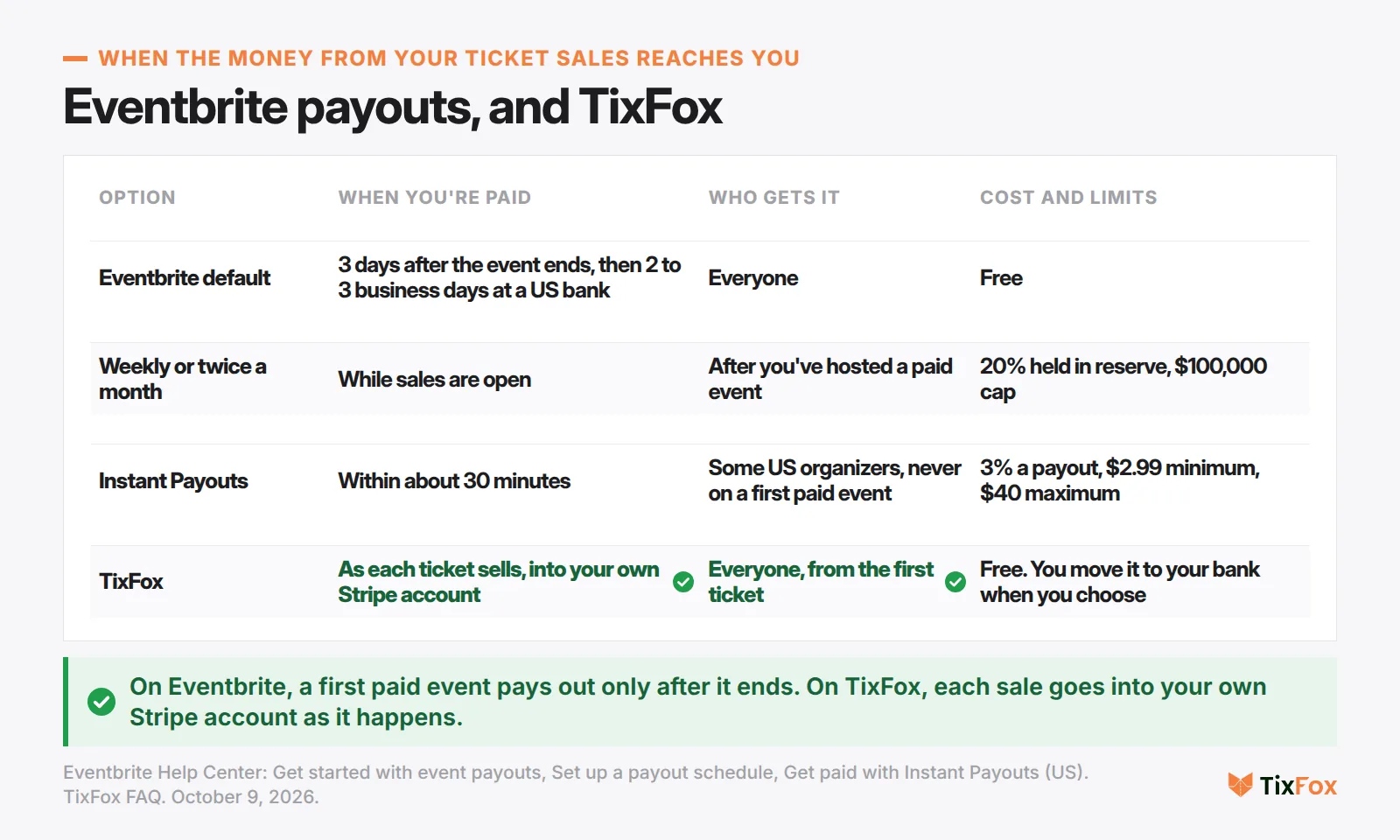
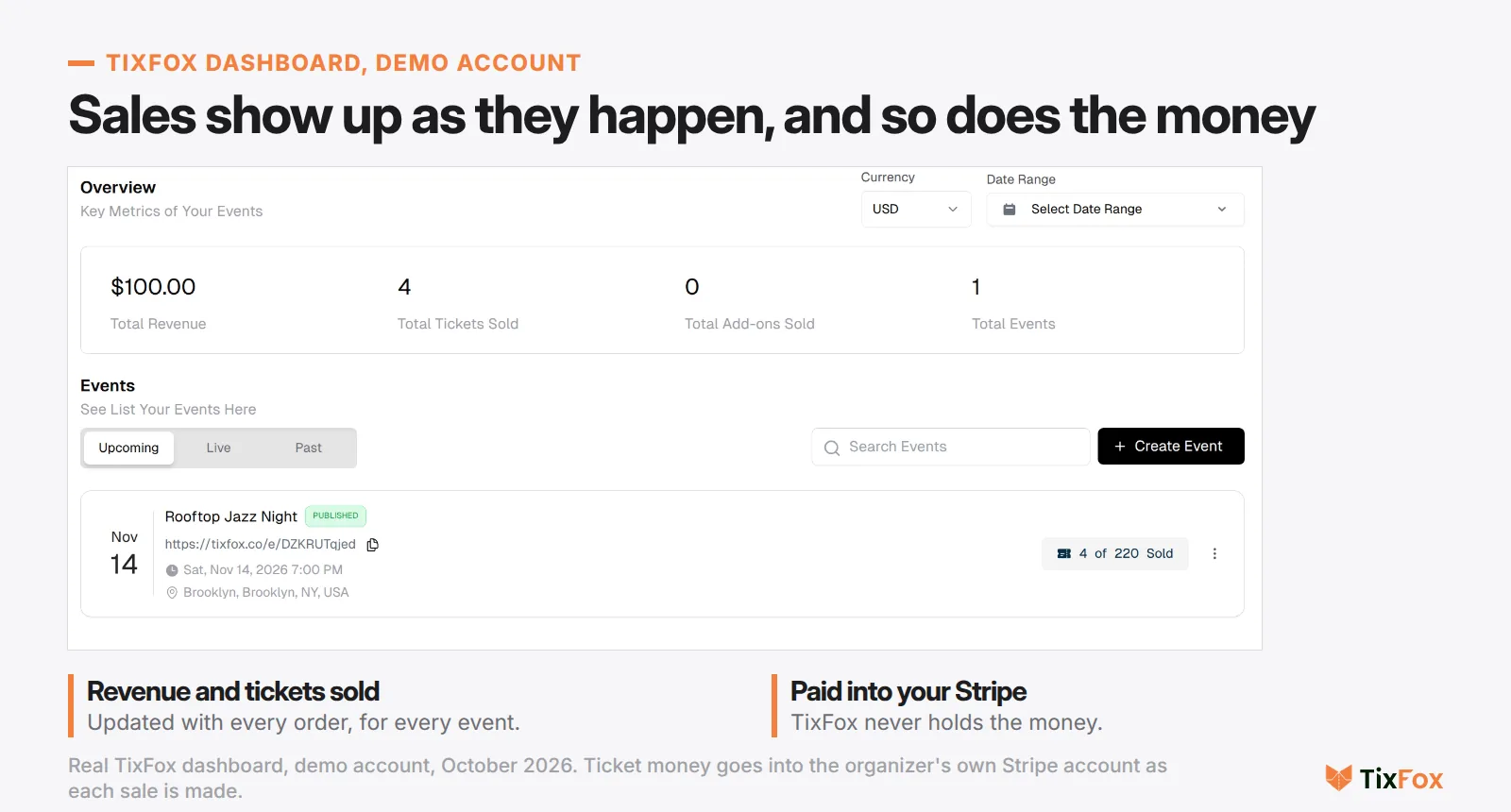
On TixFox, each sale goes into your own Stripe account as it happens, from your first ticket, and TixFox never holds the money. You move it to your bank when you choose, so you can pay a venue deposit or a caterer before the doors open.
Is Eventbrite legit?
Yes. Eventbrite is an established ticketing company, owned since March 2026 by the Italian software company Bending Spoons, which agreed to buy it for about $500 million. Trustpilot shows 4.4 out of 5 from more than 13,000 reviews. For organizers, the bigger question is whether the cost works for your event.
Eventbrite pros and cons
Pros
- Quick to set up, with no technical skill needed
- A marketplace Eventbrite says reaches 89 million people a month, plus its own ads and email tools
- A checkout many buyers already know
- Reserved seating and timed entry built in
Cons
- 3.7% + $1.79 per ticket plus 2.9% processing, a common complaint in reviews
- A first paid event pays out only after it ends
- Instant Payouts cost 3% each
- Support that reviewers find hard to reach
- Event pages that are hard to brand as your own
Is Eventbrite worth it?
Yes, for some events. Eventbrite is the better choice when:
- You're new to an area and have no audience yet. Eventbrite's marketplace and ads put your event in front of people already looking for things to do.
- You want Facebook, Instagram and TikTok promotion and paid ads run from the same place you sell tickets.
- You need reserved seating today. Eventbrite has it, and TixFox's reserved seating is coming soon.
- You run a large or complex event and want one of the tailored packages Eventbrite offers through its sales team.
If you already have an audience through your own email list, social accounts, venue or community, you may be paying for reach you don't need. That's where TixFox costs less:
- Every ticket price: $1.46 against $3.52 in fees on a $25 ticket, passed on
- When you absorb the fees, too: you keep $23.58 of a $25 ticket on TixFox against $21.55 on Eventbrite
- Money as you sell, in your own Stripe account, from your very first event
- The same 39¢ for everything: ticket tiers, discount codes, custom checkout questions, automated reminders, UTM tracking and a free check-in app for iOS and Android
If something goes wrong mid-sale, TixFox support is on WhatsApp at +1 (224) 4-TIXFOX. You can also run your own ticket price and volume through the savings calculator on our Eventbrite switching page.
How other platforms compare on a $30 ticket
Eventbrite's service fee on a $30 ticket is $2.90. Here's the platform fee alone on other ticketing sites, before card processing:
- TixFox: $0.39
- SimpleTix: $1.39 (79¢ + 2%). See SimpleTix fees
- TicketLeap: $1.60 ($1 + 2%), plus a 3% transaction fee. See TicketLeap fees
- Humanitix: $1.62 (2.1% + 99¢ in the US). See Humanitix fees
- Eventbrite: $2.90 (3.7% + $1.79)
Ticket Tailor works differently, with prepaid credits, so we've broken it down in Ticket Tailor fees.
What one organizer says about TixFox
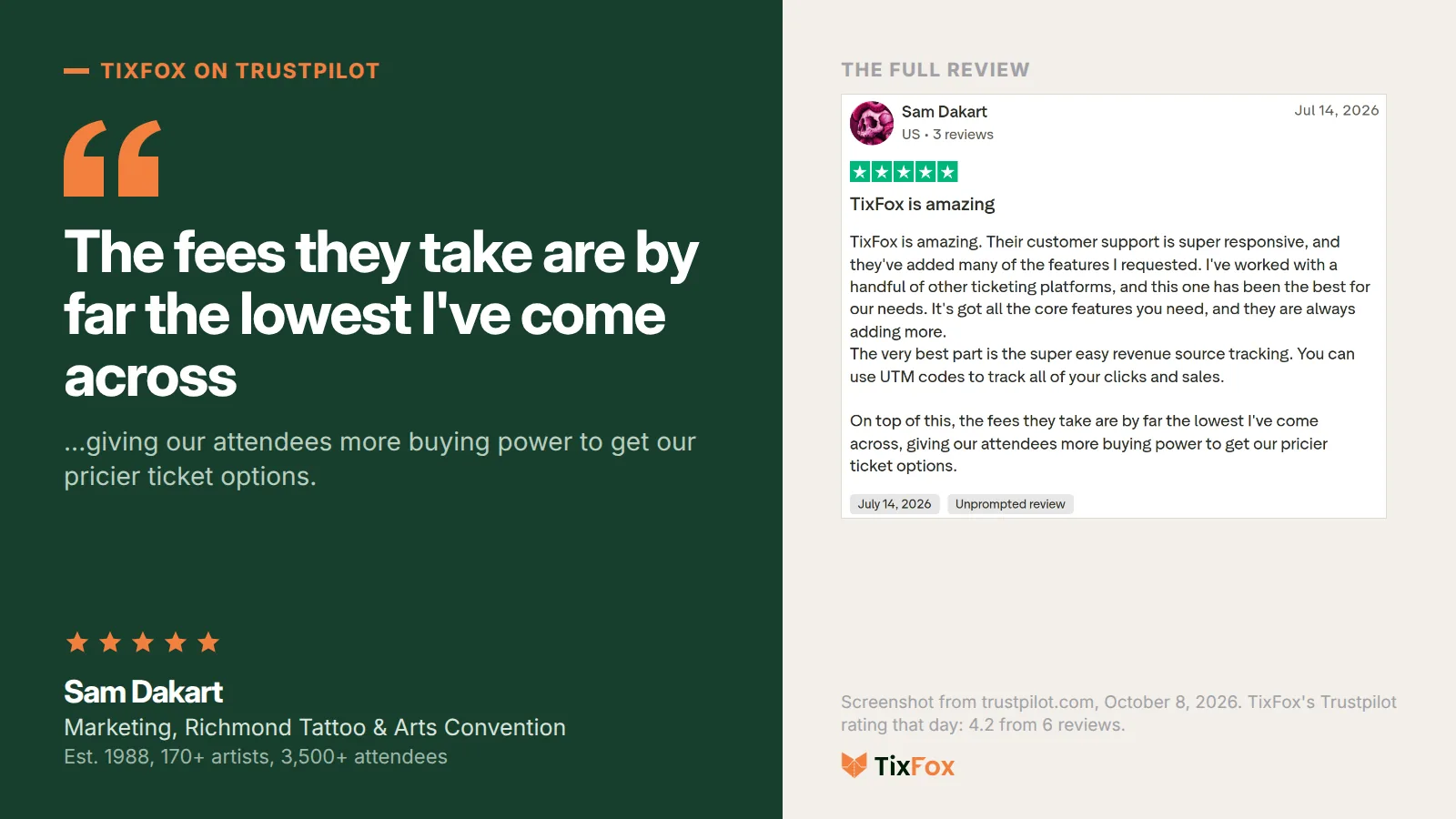
Sam Dakart handles marketing for the Richmond Tattoo & Arts Convention, which has more than 3,500 attendees. In July 2026, Sam wrote on Trustpilot that TixFox's "fees they take are by far the lowest I've come across, giving our attendees more buying power to get our pricier ticket options." You can read more of what organizers say in our TixFox reviews.
Watch how selling on TixFox works
The video shows the whole setup in under six minutes: connecting Stripe at 0:26, ticket types and the pass-or-absorb fee setting from 1:35, and what your buyers see at checkout from 3:49.
To try TixFox, create a free account, connect Stripe and put your first event on sale. Free events cost $0, and paid tickets are 39¢ each ($0.30 under $5) plus Stripe's card processing, with no monthly fee. See TixFox pricing.
FAQ
How much does Eventbrite charge per ticket?
In the US, a service fee of 3.7% + $1.79 per ticket, plus 2.9% payment processing on the total order. On a $25 ticket, that's $3.52 when buyers pay the fees.
How much does Eventbrite take from a $20 ticket?
$3.18 if your buyer pays the fees, or $3.11 taken from your $20 if you absorb them, card processing included. That's 15.6% of the ticket.
Does Eventbrite charge for free events?
No. Eventbrite says it's free for events with free tickets, and neither you nor your buyers pay ticketing fees.
How long does Eventbrite take to pay out?
Eventbrite sends your payout three business days after your event ends. A US bank then takes 2 to 3 more business days, and banks outside the US take 5 to 7. A first paid event can't be paid out before it ends.
Does Eventbrite hold your money?
Until your event ends, yes, unless you qualify for early payouts. Even then, Eventbrite holds 20% of each event's net sales in reserve until the final payout, three business days after the event ends.
How much is an Eventbrite instant payout?
3% of the amount, with a $2.99 minimum and a $40 maximum, up to $10,000 a payout. Instant Payouts are for some US organizers and aren't available on a first paid event.
Is Eventbrite cheaper than TixFox?
No. On a $25 ticket with fees passed to the buyer, Eventbrite's fees are $3.52 and TixFox's are $1.46, card processing included. TixFox is lower at every ticket price.
Where can I read Eventbrite reviews?
Capterra has the most organizer reviews (5,830, rated 4.6). G2 has 913 (4.3). Trustpilot has 13,023 (4.4), and its summary focuses on buying tickets.
Sources
- Eventbrite: Organizer pricing (US), and Help Center articles on Ticketing Fees, event payouts, payout schedules and Instant Payouts. Checked October 9, 2026.
- Reviews: Capterra, G2 and Trustpilot, October 9, 2026.
- Ownership: Bending Spoons Form 424B4 (SEC, 2026) and TechRadar on the deal.
- Stripe: Pricing (US cards).
- TixFox: Pricing and FAQ. Screens from the TixFox demo account, October 2026.
About this post: written by the TixFox team, who build ticketing software for event organizers of every size, from community nonprofits to festivals, conventions and attractions. The fee examples use Eventbrite's published US rates, and we review them every six months.
Keep more of every ticket sale.
- 39¢ per ticket, $0 on free events
- No monthly fee, no contract
- Get paid as each sale comes in