You've got a backyard, a playlist, and 50 friends who said they'd pay $30 to show up. Simple math: that's $1,500. Enough to cover the DJ, the cooler full of drinks, and maybe a taco cart if you play it right.
Then you set up an Eventbrite page and realize $150 to $200 of that money is going straight to platform fees. For a house party. In your own backyard.
That's the part nobody warns you about when they tell you to "just use a ticketing platform." The platforms built for 10,000-person festivals charge the same percentage whether you're filling a stadium or your living room. And at house party scale (20 to 80 guests), those percentages eat your budget alive.
This guide breaks down which ticketing platform actually works for house parties, how much the top options cost on a small guest list, and why the math looks completely different at this scale than it does for bigger events.
Why House Parties Need a Different Approach to Ticketing
A house party is not a concert. It's not a conference. The economics are completely different, and most ticketing platforms weren't built with your 40-person backyard show in mind.
Here's what makes house parties unique as ticketed events. You're working with a hard capacity limit, because your space is physically small. You're selling somewhere between 20 and 80 tickets, rarely more. Your ticket prices tend to sit between $15 and $50, depending on what you're offering. And your total revenue tops out at a few thousand dollars, which means every $50 lost to fees is a real hit.
On a 200-ticket concert at a rented venue, paying $580 in Eventbrite fees might be painful but survivable. On a 40-ticket house party, paying $120 in fees might be the difference between covering your costs and dipping into your own pocket.
The platform you pick matters more at this scale, not less.
The Real Fee Math: What Platforms Actually Cost for 40 Guests at $30
Let's skip the vague "low fees" claims and do the actual arithmetic. Here's what you'd pay in platform fees (not counting payment processing, which is roughly the same everywhere at 2.9% + $0.30) for a 40-person house party at $30 a ticket.
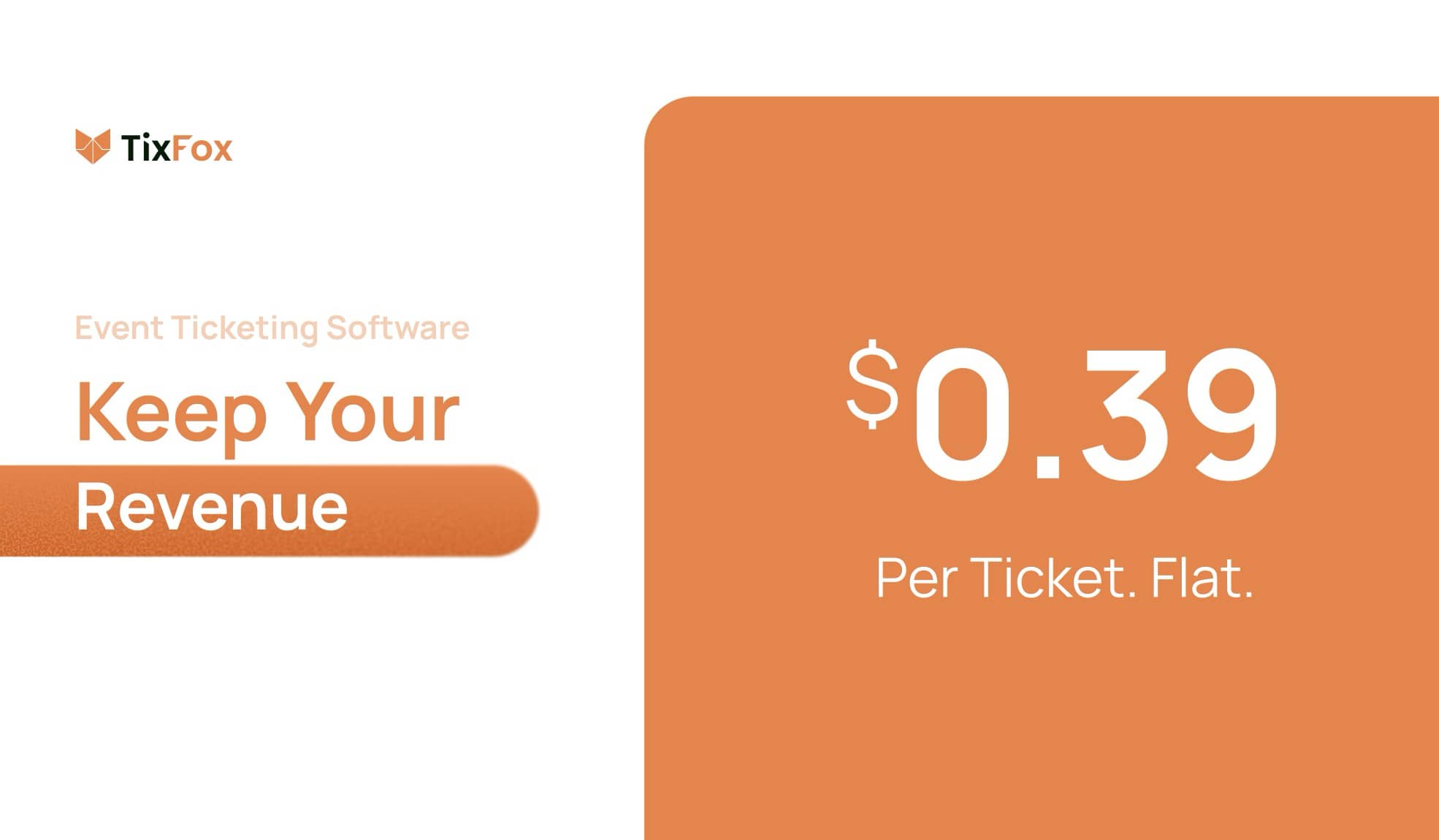
TixFox: $15.60 total At $0.39 flat per ticket, you pay $15.60 across 40 tickets. No percentage. No surprises. That's it.
Ticket Tailor: $26.00 total At $0.65 per ticket on pay-as-you-go, your platform fees come to $26.00. Still reasonable, and Ticket Tailor is a solid platform. But it's $10 more than TixFox for the same party.
SimpleTix: $55.60 total At $0.79 + 2% per ticket, you're paying $1.39 per ticket, totaling $55.60. Getting pricier.
TicketLeap: $64.00 total At $1.00 + 2% per ticket, each ticket costs you $1.60 in fees. Total: $64.00.
Eventbrite: $116.00 total At $1.79 + 3.7% per ticket, each $30 ticket carries a $2.90 platform fee. Across 40 tickets, that's $116.00 before payment processing even kicks in. On $1,200 in gross ticket sales, you've just handed over nearly 10% to the platform.
The gap between TixFox at $15.60 and Eventbrite at $116.00 is $100.40. On a house party budget, that's your ice, your cups, your speaker rental, or the tip for whoever's running the grill.
What to Actually Look for in a House Party Ticketing Platform
Not every feature that matters for a music festival matters for your house party. Here's what does.
Flat fees, not percentages. This is the single biggest factor. Percentage-based pricing punishes you twice on small events: you have fewer tickets, and each ticket's fee takes a bigger relative bite. A flat fee per ticket lets you calculate your costs in seconds and know exactly what you're keeping.
Passcode or private event protection. You don't want random strangers finding your event page and buying tickets to your house. A platform that lets you lock your event behind a passcode, so only people you've shared the code with can purchase, keeps your guest list intentional. TixFox offers passcode-protected private events for exactly this reason. You can hide the entire event page or just lock the ticket checkout, depending on how exclusive you want to be.
A mobile check-in app. Sounds overkill for a house party, right? It's actually one of the most useful features you can have. When 40 people show up at your door between 7:30 and 8:15, you need a fast way to confirm who paid and who's trying to slide in on a friend's name. A free scanning app on your phone takes two seconds per person. Hand it to a friend at the door and you're done.
Instant access to your money. If you're buying supplies the day before the party, you need that ticket revenue available now, not five to seven business days after the event ends. Platforms that use Stripe Connect, like TixFox, route money directly into your connected Stripe account as sales come in. You control your own balance. Eventbrite, by contrast, holds funds and pays out days after the event.
Simple setup. If your ticketing platform takes longer to configure than it takes to make the playlist, something's wrong. You should be able to create your event, set a ticket price, add a capacity limit, and go live in under 10 minutes.
A Quick Note on Legality
This is worth mentioning because it comes up often. In most cities, small ticketed gatherings at a private residence (generally under 50 people) don't require a special permit. But the rules vary by municipality, and some homeowner's associations or condo boards have restrictions on commercial activity in residential spaces.
Before selling tickets to any house event, check your local noise ordinances and zoning rules. If you're renting, check your lease. And if you're hosting regularly (weekly DJ nights, monthly dinner parties), you're more likely to need a permit than if you're throwing a one-off birthday party.
None of this is legal advice. It's just a heads-up to do a quick check before you sell 60 tickets to a rager in your apartment.
Three House Party Scenarios Where the Fee Difference Really Shows
Scenario 1: The Living Room Concert You've convinced a local acoustic artist to play your living room for 25 friends at $40 a head. Gross revenue: $1,000. On TixFox, you pay $9.75 in platform fees. On Eventbrite, you pay $81.75. That $72 difference could pay the artist more, or it could buy the nice wine instead of the box stuff.
Scenario 2: The Backyard Birthday Bash Your friend's 30th. You're selling 50 tickets at $25 to cover the taco truck and a live DJ. Gross revenue: $1,250. TixFox fees: $19.50. Eventbrite fees: $135.75. The $116 gap is almost the cost of the DJ.
Scenario 3: The Rooftop Dinner Party An intimate 20-person dinner on your building's rooftop. Tickets are $75 each because you're hiring a private chef. Gross: $1,500. TixFox fees: $7.80. Eventbrite fees: $91.30. You're saving $83.50, which more than covers the wine pairings.
In every case, the flat-fee model wins at house party scale. The percentage-based platforms were designed for a different kind of event, and their pricing reflects that.
What About Free Platforms Like Partiful?
Fair question. Partiful is a great free RSVP tool for casual gatherings where you're not charging admission. If your house party is free to attend and you just want headcounts and a nice event page to text out, Partiful works well.
But the moment you want to charge for tickets, Partiful isn't the right tool. It doesn't handle payments, issue scannable tickets, or give you the kind of attendee management that a proper ticketing platform does. If money is changing hands, you want a platform that tracks payments, issues unique tickets, prevents duplicates at the door, and gives you a paper trail.
For free parties, use Partiful or even a Google Form. For ticketed house parties where you need to collect money and control your guest list, use a real ticketing platform.
Getting Started: From Zero to Ticket Sales in 10 Minutes
Here's what the actual setup looks like if you're using a flat-fee platform like TixFox.
Create a free account. No credit card required, no subscription, no setup fee. Name your event, add the date and a short description. You don't need to share the physical address here; you can send that privately to confirmed ticket holders.
Set your ticket price and your capacity limit. If your backyard fits 50 people comfortably, set the cap at 50. The platform will automatically stop sales when you hit it.
If you want the event private, enable passcode protection. Share the code over group text or DM. Only people with the code can see the event or buy tickets.
Share the ticket link. Text it. Put it in an Instagram story. Drop it in the group chat. Your guests buy tickets on their phone in about 30 seconds.
On the night of the party, open the free check-in app, hand your phone to whoever's at the door, and let them scan QR codes as people arrive. Done.
You can see TixFox's full pricing breakdown here if you want to run the numbers for your specific event.
Frequently Asked Questions
Do I need a ticketing platform for a house party, or can I just Venmo everyone? You can, but you'll spend the night chasing payments, arguing about who paid and who didn't, and manually counting headcount. A ticketing platform gives you a clear guest list, proof of payment for every person, and a way to cap attendance so you don't oversell your space. For any ticketed event with more than about 15 people, it's worth the small per-ticket cost.
What's the cheapest ticketing platform for a small house party? For paid tickets, TixFox is currently the lowest at $0.39 flat per ticket with no percentage fee. On a 40-ticket event, that's $15.60 in total platform fees. Ticket Tailor is also affordable at $0.65 per ticket. Both are significantly cheaper than Eventbrite's percentage-based model for small events.
Can I keep my home address private when selling tickets? Yes. Most ticketing platforms let you withhold the venue address from the public event page. You can send the location separately via text or email to confirmed ticket holders. On TixFox, passcode protection adds another layer: people can't even see your event details unless they have the code.
How do I handle capacity limits for a house party? Set your ticket quantity to match your comfortable capacity. If your space fits 40 people, sell 40 tickets. The platform stops sales automatically. This is one of the biggest advantages of ticketing versus informal RSVPs: you won't end up with 70 people in a space built for 35.
Do I need to collect sales tax on house party tickets? Tax rules vary by state and municipality. In general, one-off social gatherings aren't treated the same as commercial events, but if you're hosting ticketed events regularly, you may cross into territory where tax obligations apply. Talk to a local accountant if you're doing this often. For a one-time party, most hosts don't collect sales tax, but that's your call to make.
TixFox is built for exactly this kind of event: small, personal, and on a budget. If you want to try it, create a free account and set up your first house party event in about 10 minutes. No credit card. No monthly fees. Just $0.39 per ticket sold.
Keep more of every ticket sale.
- 39¢ per ticket, $0 on free events
- No monthly fee, no contract
- Get paid as each sale comes in