You have a local business interested in sponsoring your event. It asks what $1,500 would buy. Can you send an answer today, or do you need to invent a package while the conversation is happening?
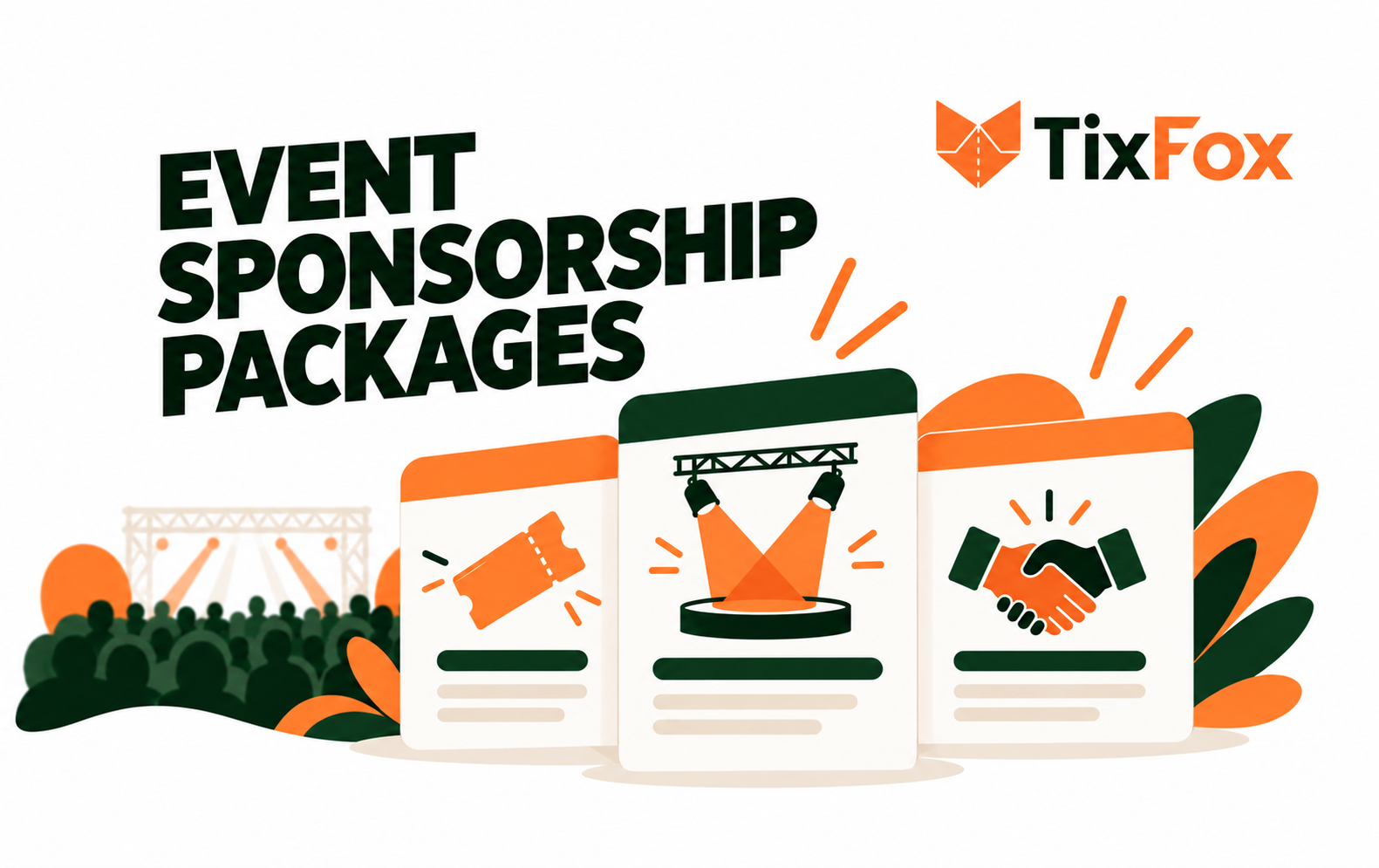
An event sponsorship package gives you a clear answer. It bundles specific benefits—such as an activation space, event emails and guest tickets—at a stated price. The sponsor can see what it will receive, and your team can see what it has promised to deliver.
Below is a three-tier example for a small festival, a practical way to set prices, and a free worksheet you can copy. The example prices are illustrative, not going rates. Your audience, venue and delivery costs should determine your own offer.
What should an event sponsorship package include?
A useful package answers five questions without a follow-up call:
Who will the sponsor reach? Describe the audience and say whether attendance figures come from a previous event or a forecast.
What exactly will the sponsor get? Give quantities, locations and dates: one 10 × 10 ft space, two scheduled social posts, six tickets.
What does it cost? State the price, payment dates and any production costs billed separately.
How many are available? Set limits for space, stage time and exclusive categories.
How will you show what happened? Agree on a short post-event report and the metrics you can actually collect.
Those details matter more than the names of the tiers. “Premium visibility” could mean a banner by the entrance to one organizer and a logo at the bottom of a web page to another.
Start with the sponsor's goal
Think about why a business would spend the money. A bakery might want people to try a product. A local employer may want to meet potential hires. A bank could be looking for a visible role in a community event. Each needs a different benefit.
Ask prospective sponsors which outcome matters most, then match it to inventory you control:
Sponsor goal | Possible benefit | Practical measure |
|---|---|---|
Local awareness | Named activity and agreed event signage | Estimated attendance, placement photos and content reach |
Product trial | Staffed sampling space | Samples distributed and visits to a tracked page |
Ticket sales | Partner promotion with a unique link or code | Tracked visits and purchases |
Customer hospitality | Guest ticket allocation | Tickets issued and checked in |
Community impact | Support for an accessible or free program | Program delivery and participation counts |
Only offer what you can control and measure. Ticket buyers should not be handed to a sponsor as a contact list. If lead collection is part of an activation, plan a separate opt-in process and agree on who will manage the information.
Check what you can actually sell
List the booths, stage or activity naming, demonstration time, signs, email placements, social posts, tickets and any approved content after the event. For each item, note the limit and the work involved.
An entrance banner may need venue approval, printing, installation and removal. A demonstration needs power, a staff member and a schedule slot. An email placement needs a send date and an audience size you can substantiate.
This is where many packages improve before you price them. If your site plan fits three booths, you cannot promise one to four sponsors. If another partner already has beverage exclusivity, a new drinks sponsor cannot receive the same right. Check venue contracts and supplier agreements for restrictions on sampling, signs, food, alcohol and use of trademarks.
Event sponsorship package examples
Here is a sample menu for a fictional one-day food festival. The organizer is planning for 2,000 attendees, but that figure is a forecast, not a confirmed audience. The prices show how benefits might step up across three tiers; they are not market benchmarks.
Benefit | Community partner — $500 | Experience partner — $1,500 | Presenting partner — $3,500 |
|---|---|---|---|
Availability | Up to 6 | Up to 3 | 1 |
Event page | Sponsor name and link | Logo and link | Prominent logo and link |
On-site presence | Shared sponsor board | One 10 × 10 ft activation space, subject to venue approval | One 10 × 20 ft activation space and named demonstration area, subject to venue approval |
Organizer promotion | One group thank-you post | One dedicated social post and one event email mention | Two dedicated social posts and two event email mentions |
Guest tickets | 2 | 6 | 12 |
Measurement | Delivery photos and attendance summary | Delivery photos, attendance summary and unique partner link results | The same report plus agreed demonstration attendance estimate |
Production | Sponsor supplies artwork | Sponsor supplies staffing and activation materials | Sponsor supplies staffing and activation materials; stage production scope agreed separately |
The $500 sponsor receives recognition. The $1,500 sponsor can meet attendees in person. The $3,500 sponsor gets a scarce named experience and more promotion. That is easier to understand than selling three different logo sizes.
Before offering these tiers, check whether the event can accommodate all packages if every one sells. Three experience partners and one presenting partner need four activation spaces. Confirm the site plan, power and staff coverage before promising them.
The same approach works for other events, but the inventory changes. A community theater might sell a season program placement and a named performance night. A workshop might offer an attendee breakfast and a short, relevant demonstration. A charity run might have a water station or volunteer support opportunity. Choose benefits that belong naturally in the event rather than copying a festival's booth package.
How to price an event sponsorship package
Start with the cost of keeping each promise. Include printing, equipment, staff time, venue charges and a contingency for changes. Then consider audience fit, the scarcity of the benefit, previous results if you have them, and the prices of genuinely comparable local offers.
Calculate a delivery cost for each package:
Delivery cost = direct production costs + staff time + allocated overhead + contingency
Suppose a $1,500 experience package requires $180 for space and equipment, $120 for design and printing, $150 in staff time, and $100 in allocated overhead. Add a $100 contingency and the delivery cost is $650. At $1,500, that leaves $850 before other event costs and taxes. If a sponsor asks for a custom activity costing another $900, the same price no longer works.
This calculation gives you a cost floor, not a universal selling price. The value to a sponsor also depends on how closely your attendees match its customers and what it can do with the space or promotion. If you are running a first-year event, show the basis for your forecast rather than presenting capacity as past attendance.
Keep cash and in-kind support separate in your event budget. A print shop donating signs may save a real expense, but the retail value of those signs cannot pay a venue deposit. Record who covers delivery and installation.
Price extras separately
Some requests are too specific to hide inside a standard tier. You could offer an additional email mention, a larger footprint or a named activity as an add-on, provided you can fulfill it. Quote its production cost and price, then update the written scope. If a sponsor wants exclusivity, define the exact category and duration before assigning a price.
Free event sponsorship package template
Copy this worksheet once for each tier. It is an internal planning sheet; turn the completed details into a clean sponsor-facing page when you are ready to sell.
Field | Fill in for your event |
|---|---|
Name, price and number available | |
Sponsor goal this package serves | |
Audience estimate, source and date | |
On-site benefits: location, size and schedule | |
Digital benefits: quantity and publication dates | |
Guest tickets or hospitality | |
Sponsor supplies: staff, artwork, products, equipment | |
Organizer delivery costs and contingency | |
Exclusivity or category restrictions | |
Artwork approval and payment dates | |
Metrics, collection method and report date |
Before sending it, ask two people to read it: a potential sponsor and the person running your event. Can the sponsor identify every benefit included in the price? Can your teammate assign an owner and due date to each one? Fix the gaps they find.
A package is a repeatable offer. When you pitch one particular company, explain why its goals fit the event and recommend the relevant tier. The TixFox sponsorship proposal guide has a full proposal structure and outreach example for that step.
After a sponsor says yes
Put the final benefits, price, deadlines and responsibilities in a written agreement. Confirm who supplies artwork and equipment, what the venue permits, what any exclusivity covers, and what happens if the event changes. If the sponsor provides products or services, include quantities and delivery dates.
During the event, collect proof while it is easy to get: approved photos of signage, counts from staffed activations, and the results of any tracked promotion. In the report, distinguish tickets sold from people who actually checked in. Be candid about measures you could not collect. A useful report gives the sponsor a basis for deciding whether to return next year.
Frequently asked questions
How many sponsorship tiers should an event offer?
For a small event, two or three distinct choices are usually easier to explain and deliver than a long menu. You can also offer one core package with a few separately priced add-ons. The right number depends on your actual inventory.
Should sponsorship packages include custom options?
Start with the nearest standard tier and change the benefits that matter to that sponsor. Recalculate the delivery cost, check that the inventory is available, and record the new scope and price in writing.
Should a new event publish sponsorship prices?
A stated price helps a potential sponsor decide whether the offer fits its budget. For a large custom activation, give a starting price and explain which production choices affect the final quote.
Can I promise sponsors attendee contact details?
Do not treat a ticket purchase as permission to share someone's contact details with a sponsor. If the sponsor needs leads, create an explicit opt-in opportunity at its activation and agree on the collection and follow-up process in advance.
What should a post-event sponsor report include?
Show which promised benefits were delivered, with photos or links where useful. Add agreed attendance and campaign figures, explain any changes, and include the measurements you planned before the event. Total attendance alone does not show whether people visited a sponsor's booth.
Make the package easy to deliver
Before you offer a sponsorship tier, walk through it with the person who will run the event. Confirm the space, the schedule, the staff and the cost. A package that is clear to a sponsor should be just as clear to the team delivering it.
If a sponsor will help promote ticket sales, TixFox lets organizers use a distinct campaign link or discount code for that partner and review the resulting sales. Pair that data with the on-site measures your team records. Create your event on TixFox when the date, ticket offer and sponsor plan are ready.