"Our TikTok specifically is doing amazing… 14k views combined. My local community seems super excited… lots of comments saying so, but no one seems to want to buy tickets." A workshop host posted that on Reddit two days before their first event. Sign-ups so far: zero.
If your event tickets are not selling while your posts are doing fine, the problem usually isn't interest. It's that nothing tells people to buy now, so they don't.
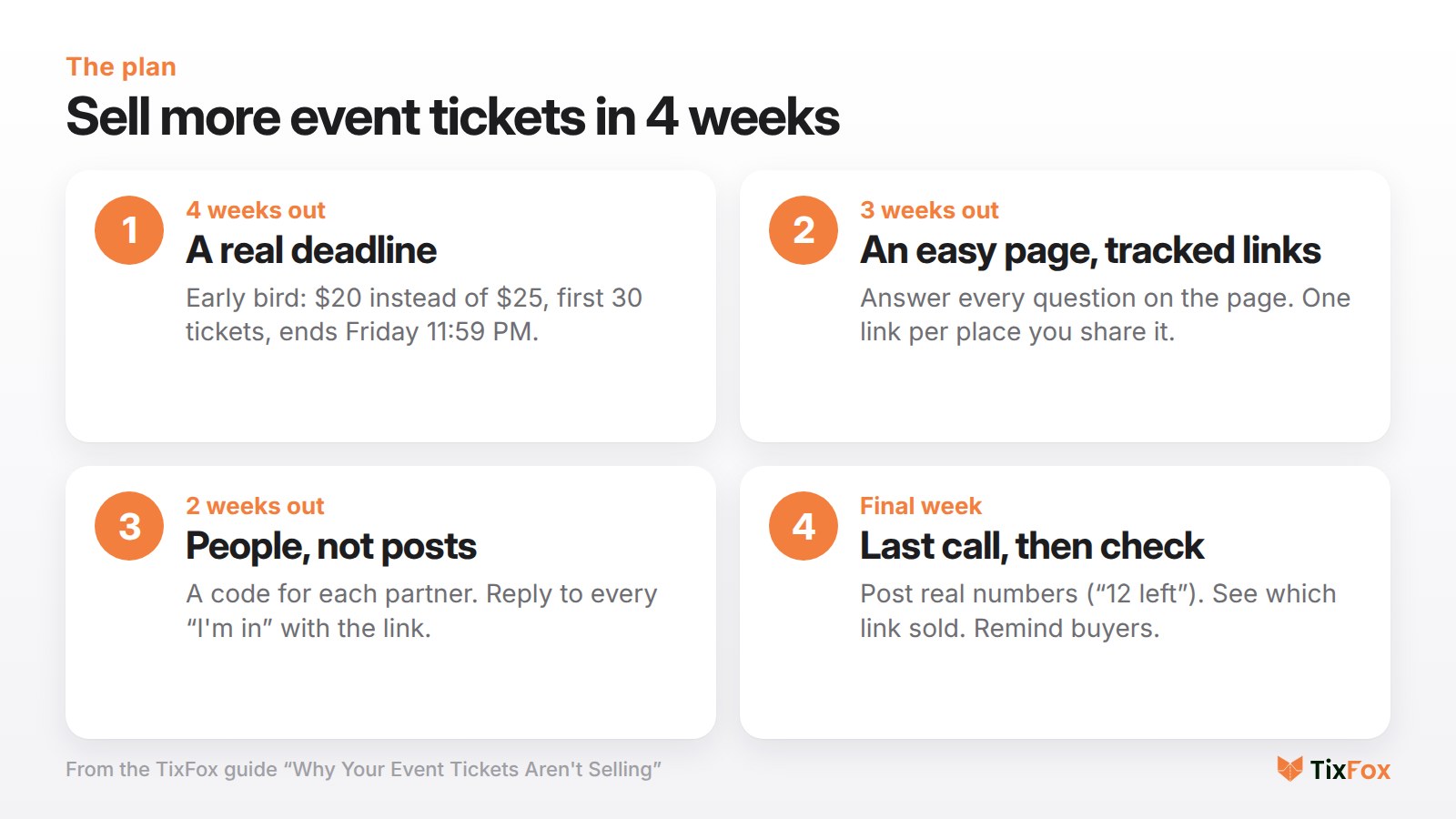
The short answer: event tickets stop selling when people have no reason to buy today, when the event page leaves them with questions, and when you can't see which promotion actually sells. The fix is a 4-week plan:
- 4 weeks out: launch with an early-bird price that really ends.
- 3 weeks out: make the page answer every question, and give every place you share it its own tracked link.
- 2 weeks out: sell through people, not posts: partner codes and direct replies.
- Final week: a last call with true numbers, then do more of whatever sold.
The rest of this guide shows why each step works (with the research behind it) and exactly how to set it up.
Watch the 4-week plan in 5 minutes
Prefer to watch? The video on YouTube walks through every step on a real event in TixFox.
What 1,670 organizer posts say about slow ticket sales
Before writing this, we read every post in r/EventProduction from October 2025 to October 2026: 1,670 posts from people who run events. Selling tickets and getting people to show up came up in 88 posts and 462 comments. That's more than the questions about which ticketing platform to use (74 posts, 454 comments), which is the thing most ticketing blogs write about.
The same story keeps coming up in different words:
- A venue promoter booking local bands: "we often times have unsold tickets by the time the event comes around." (December 2025)
- A music marketer on Facebook event ads: "I could still get a ton of event responses, but they didn't seem to translate to actual people showing up nearly as well." (August 2026)
- A promoter who emailed 7,000 past buyers with the subject "Last discounted tickets for event X": "almost no opens and almost no clicks." (May 2026)
- An organizer of free events: "waiting 1 hour, for no one on the list to actually show up." (September 2026)
Notice what's missing. Most of these organizers aren't short on attention. They have views, RSVPs, "Interested" clicks and email lists. The gap is between attention and a purchase, and more posting doesn't close it. The four steps below do.
Why people say "I'm in" and still don't buy
In 2010, two researchers, Suzanne Shu and Ayelet Gneezy, gave people a voucher for coffee and cake at a local bakery. Some vouchers expired in three weeks. Others were good for two months.
The two-month group felt more confident they'd use it. They didn't. About 30% of people with the three-week voucher went and claimed their coffee and cake. With two months, only 6% did (Shu & Gneezy, Journal of Marketing Research, 2010).
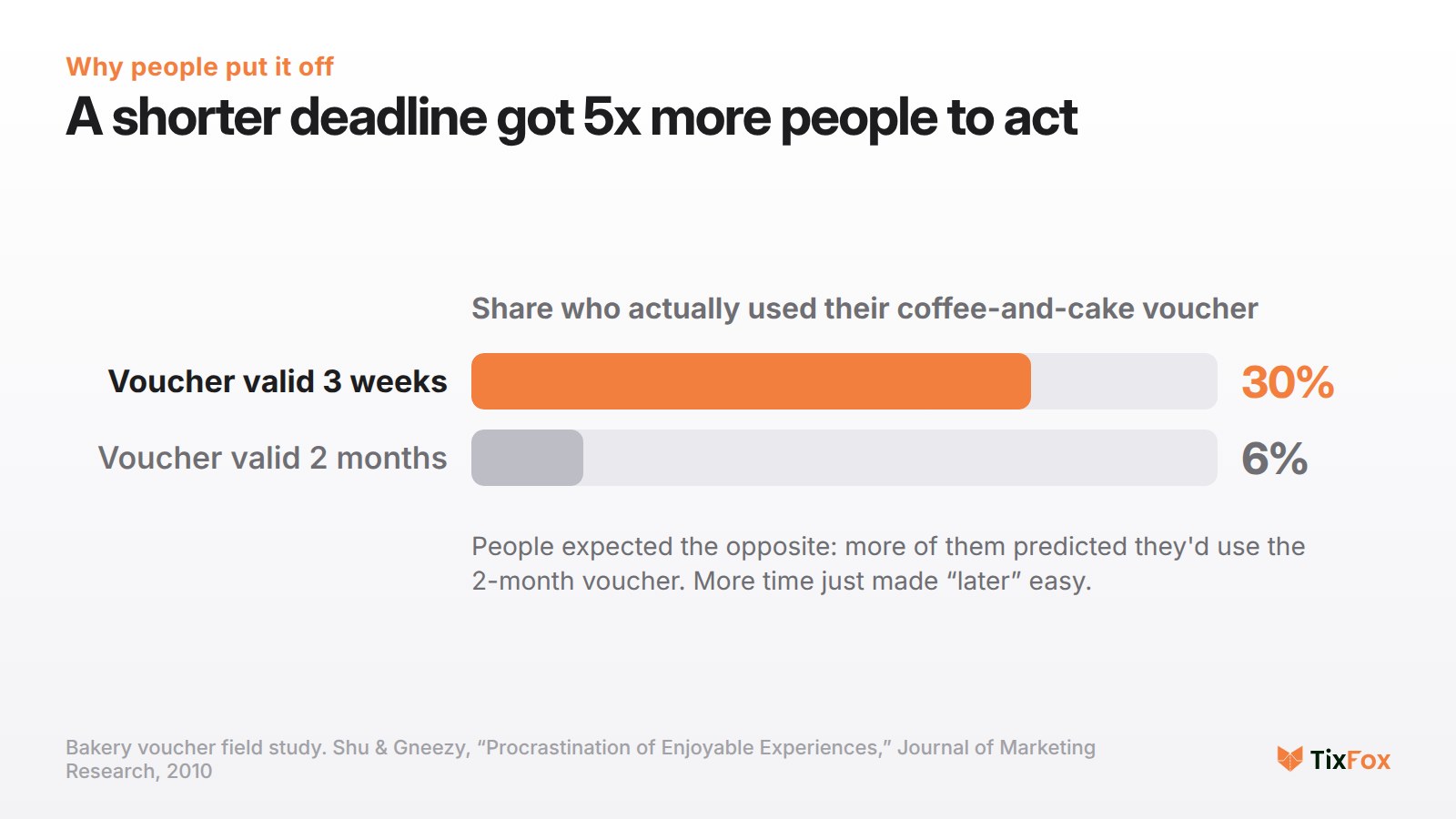
More time made "later" easy, and later never came. Data: Shu & Gneezy (2010).
Your event works the same way. The people in your comments meant it when they wrote "count me in!!" But your tickets are on sale for five weeks, so buying can always happen tomorrow. People treat anything fun without a deadline like this, and your audience is no exception.
So stop chasing likes. Give people a reason to buy now, make buying effortless, and find out which of your efforts actually sell.
Step 1 (4 weeks out): Launch with a deadline that's real
Open sales with an early-bird price that ends on a specific date. Not "limited time." A date, a time and a number: $20 instead of $25, for the first 30 tickets, until Friday at 11:59 PM.
Three details make this work.
Keep the window short
About a week is right for a local event that goes on sale four to six weeks out. A two-month early bird is the bakery's two-month voucher. People will wait.
Make the discount big enough to notice
$5 off a $25 ticket gets attention. $1 off doesn't change anyone's plans.
When it ends, let it end
If you extend the early bird "by popular demand," your audience learns that your deadlines are fake. Next time they'll wait for the extension. Honest deadlines are the only kind that keep working.
In TixFox, an early bird is just a ticket type with its own price, quantity and sale end date. It closes on its own at the time you set, even if you're asleep.
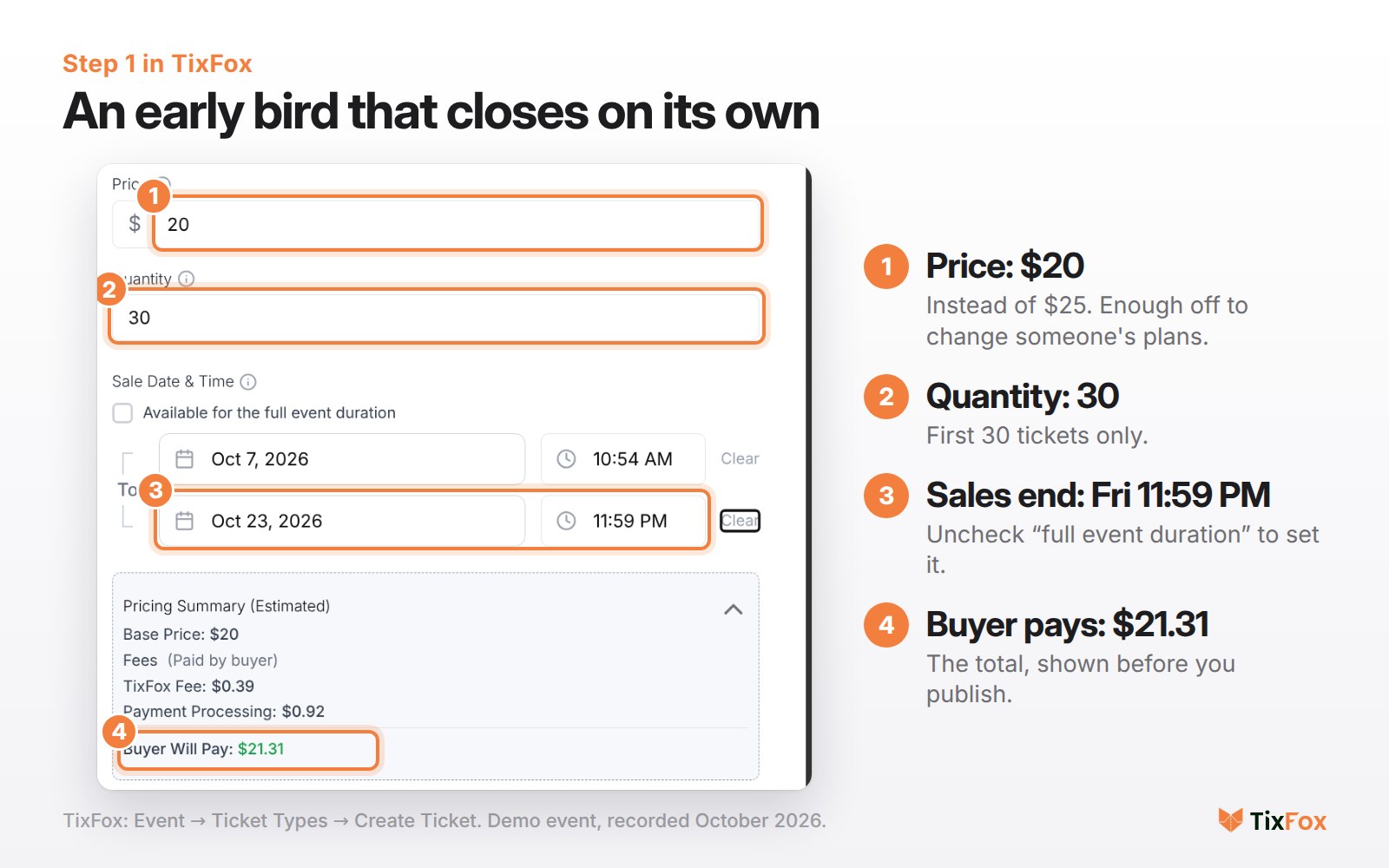
Ticket Types → Create Ticket. Uncheck "Available for the full event duration" to set the end date. The pricing summary shows exactly what the buyer will pay.
Post the deadline everywhere you announce the event: "Early bird: $20 until Friday, or until 30 are gone." Then say it again on Thursday.
Step 2 (3 weeks out): Make the event page answer every question
Someone taps your link from an Instagram Story. They have one thumb free and about ten seconds of attention. If they have to wonder what time it starts, what's included or what it really costs, they close the tab and plan to come back. You already know how "later" ends.
Check your page against this list:
- A real photo, ideally from your last event with real people in it
- The date and time, including when doors open
- The place, with an address that opens in maps
- What happens when: "Doors 7 PM, music from 7:30, two sets"
- The full price the buyer will pay
- Your refund policy, in one sentence
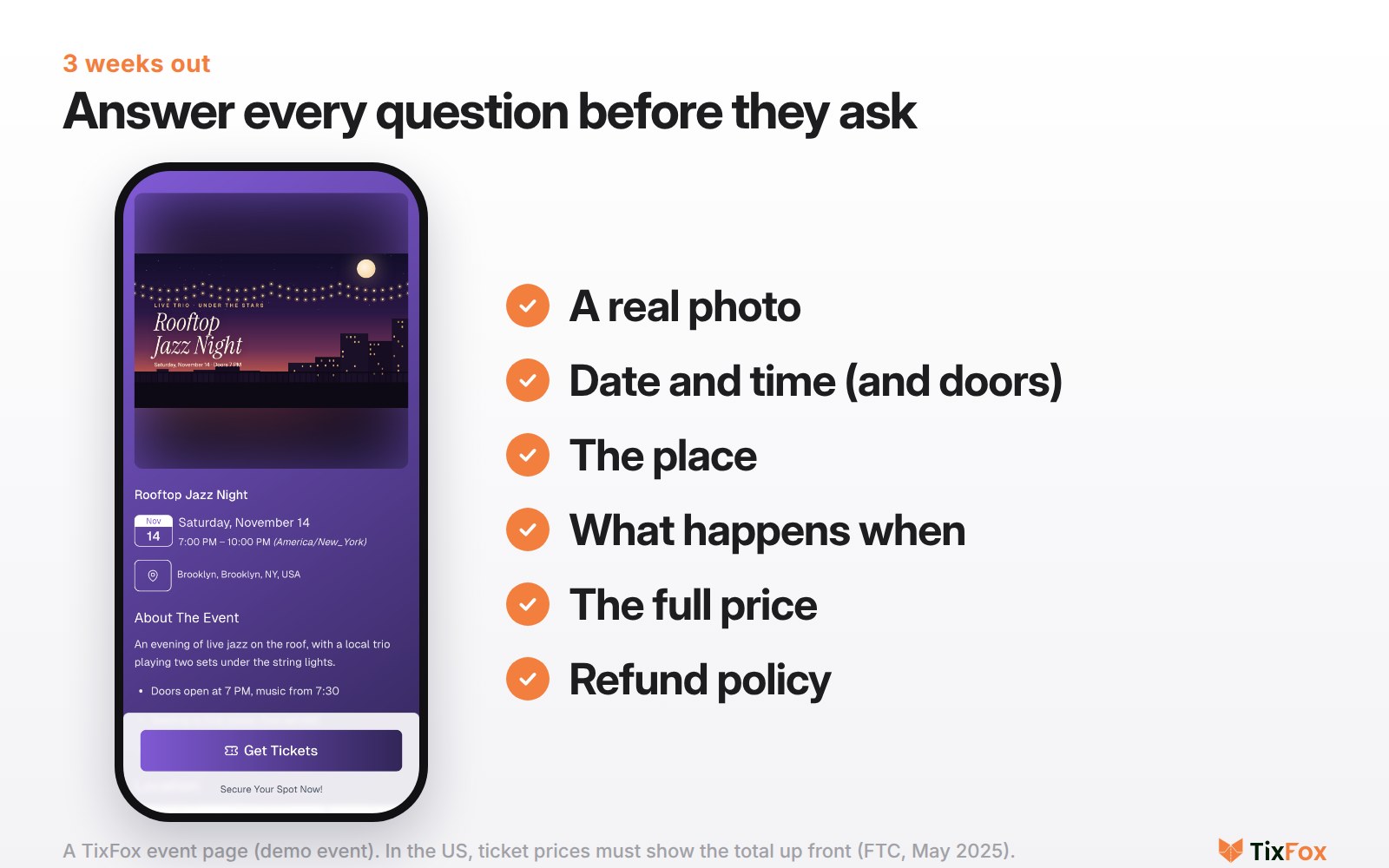
The real Rooftop Jazz Night page on TixFox, checked against the list.
On price: since May 12, 2025, US rules require live-event tickets to show the total price, including mandatory fees, up front (FTC Rule on Unfair or Deceptive Fees). Whatever platform you use, put the number people will actually pay on your posts too. TixFox lets you choose whether the buyer or you covers the fees, and its pricing summary shows the buyer's total before you publish.
Give every place you share it its own link
This is the part almost nobody does, and it's why most organizers are guessing.
Make one link for each place you promote: your Instagram bio, your Stories, your email, the QR code on the flyer at the coffee shop. Same event page every time. Each link just carries a small label (a UTM tag) that tells you where a buyer came from.
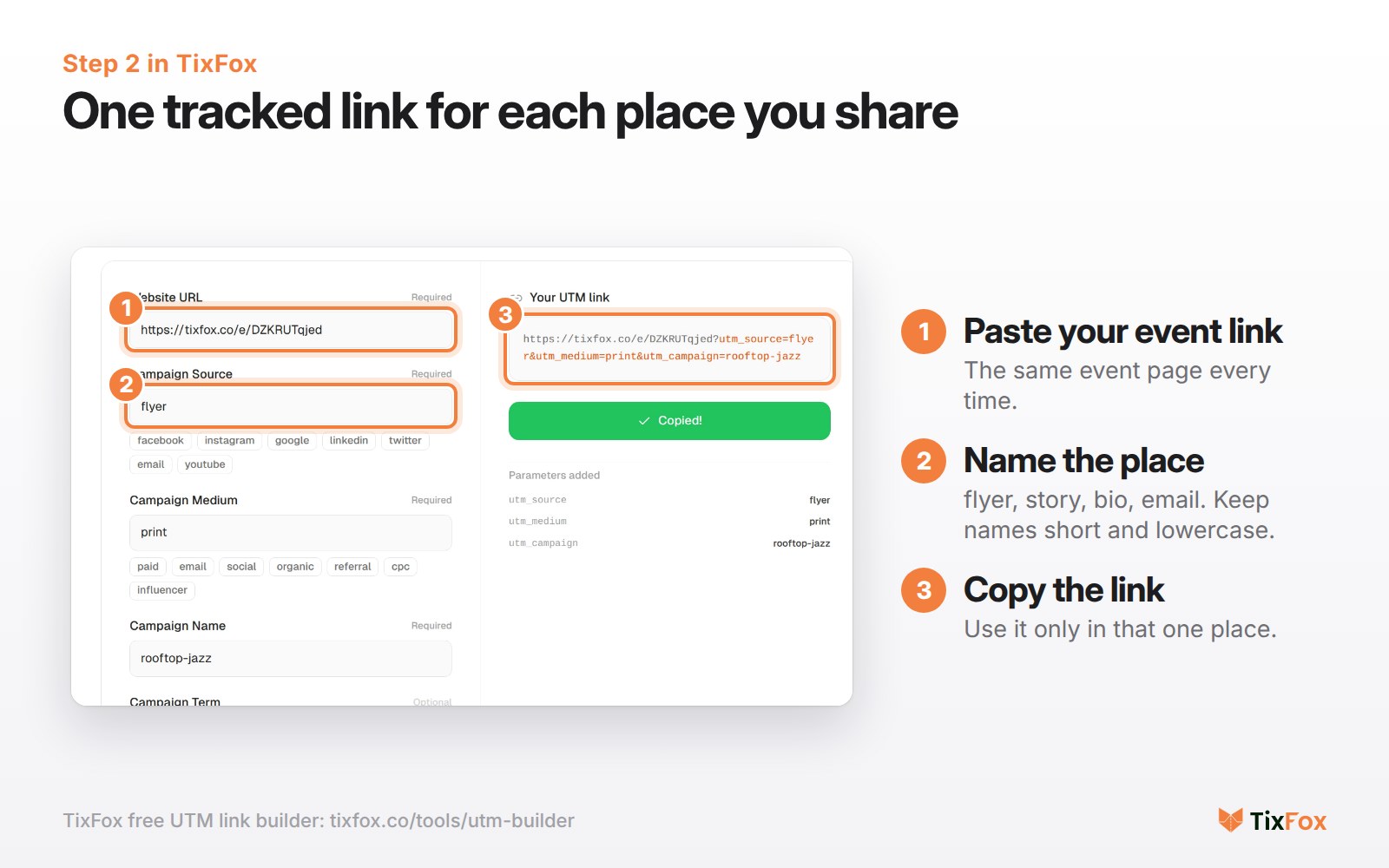
The free UTM link builder: paste your event link, name the source, copy.
Two tips that save headaches later. Keep source names short and consistent (bio, story, email, flyer), because "Flyer" and "flyer" show up as two different sources. And make a separate link for each partner, which leads straight into step 3.
Run your next event on TixFox: early birds that close on time, tracked links and partner codes are all included, free to start, 39¢ per paid ticket. Create your event free.
Step 3 (2 weeks out): Sell through people, not posts
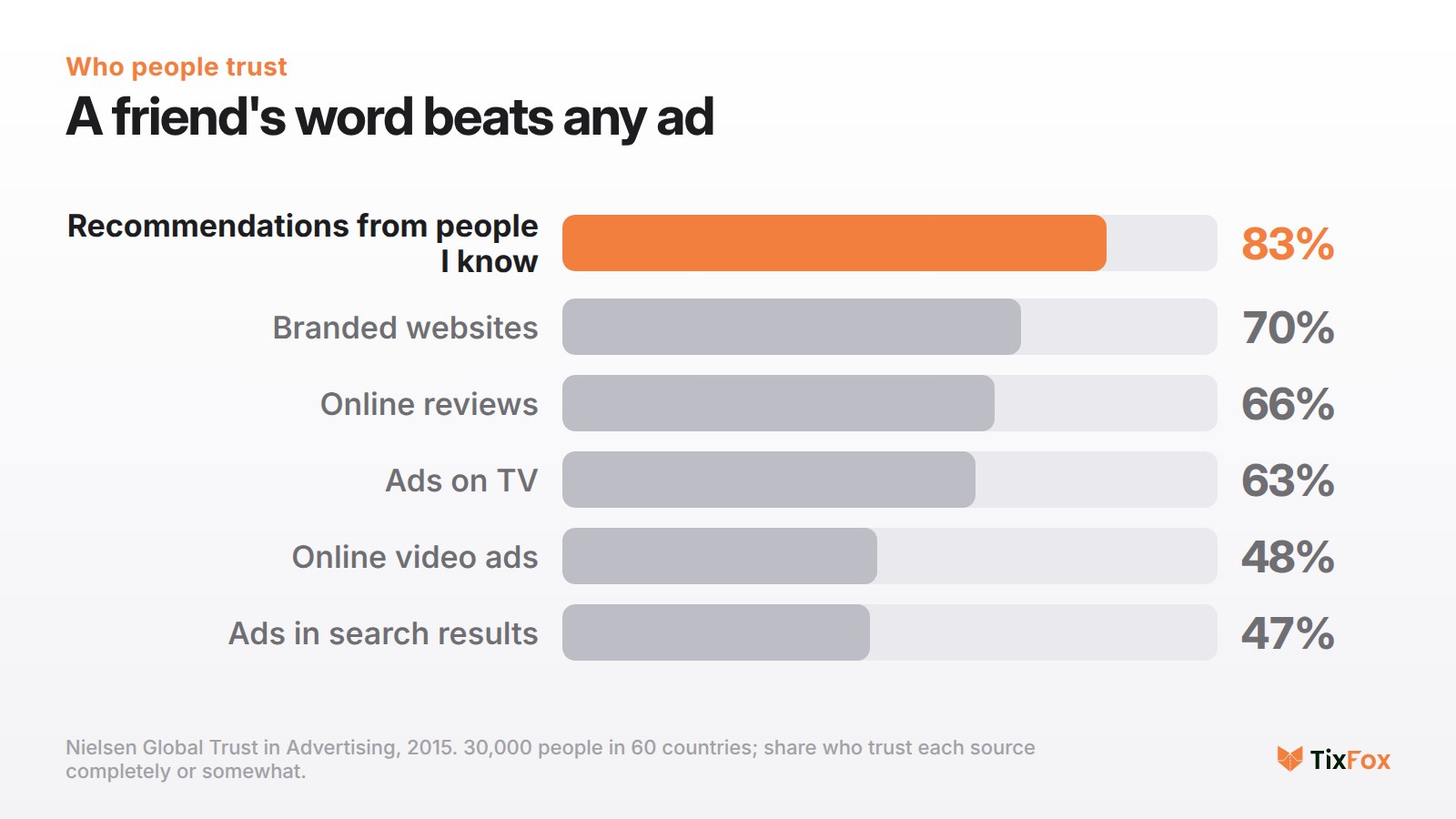
Your post is one voice. The band has fans. The venue has regulars. Your friends have group chats. Every one of those people is more convincing than you are, because people trust someone they know more than any ad. In Nielsen's survey of 30,000 people across 60 countries, 83% said they trust recommendations from people they know, the highest of any source measured. Online video ads: 48% (Nielsen Global Trust in Advertising, 2015).
So give each of your helpers their own code. TRIO for the band's fans, ROOFTOP for the venue's regulars, 10% off so they have a reason to share it. You'll see exactly how many tickets each code sold, which tells you who's really moving tickets and who to work with again.
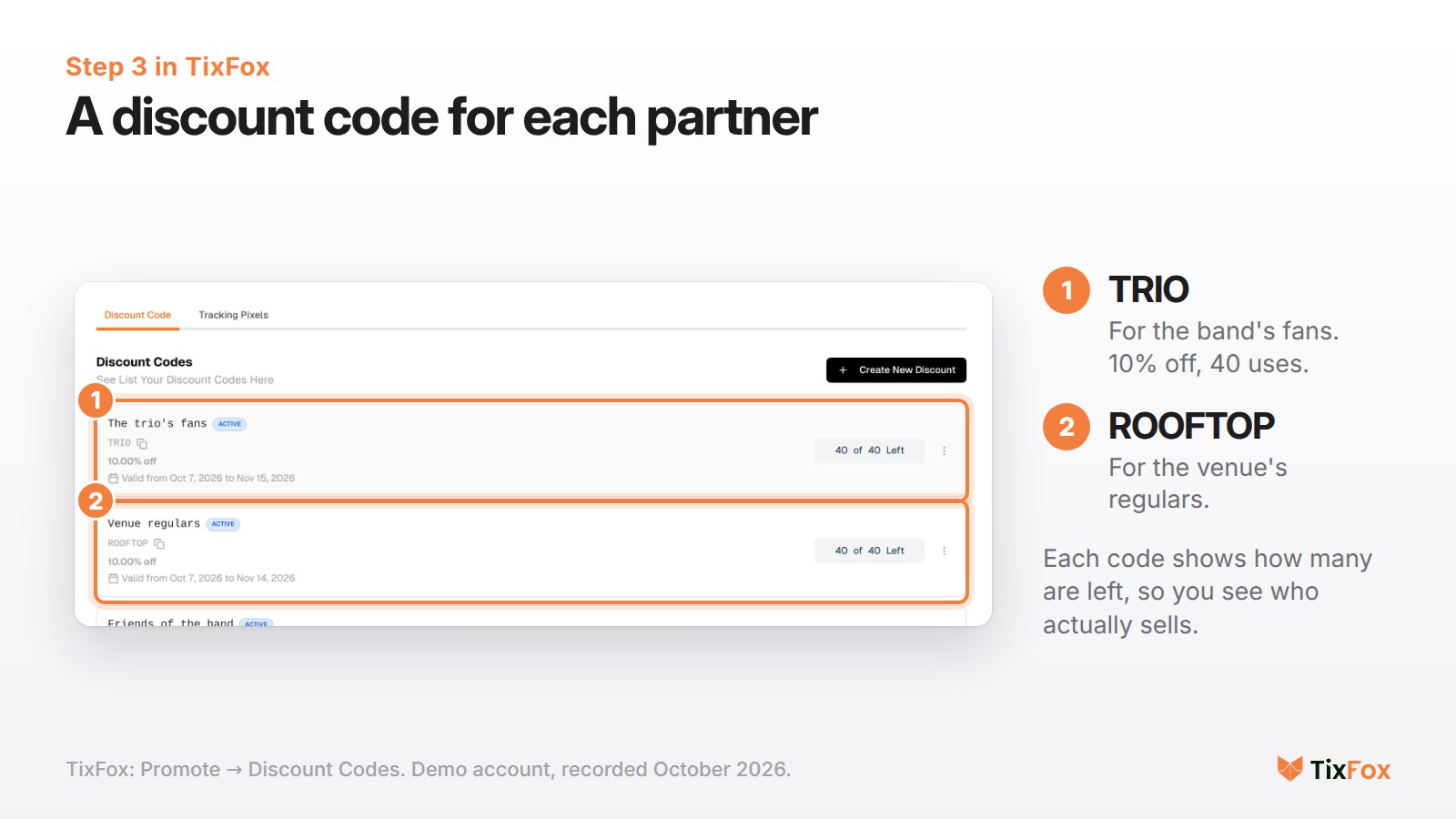
Promote → Discount Codes. Set a usage limit and an end date so each code has its own deadline.
Reply to every "I'm in" with the link
Go back to those comments. Every "omg I'm so in" gets a reply: "So glad! Here's the link. Early bird ends Friday." Same for the friends who said "count me in" at the bar.
It feels pushy. In practice, people rarely mind. Across studies where people asked more than 14,000 strangers for small favors, the askers underestimated how many people would say yes by about half (Flynn & Lake, 2008; Bohns, 2016). We assume a direct ask will annoy people. Mostly, it just reminds them to do what they already meant to do.
Step 4 (final week): A last call with true numbers, then check what sold
Plenty of people decide in the last few days, so don't go quiet now. Post what's true: "12 left." "Price goes up to $30 at the door." Real numbers create urgency. Fake ones ("almost sold out!" with 60 seats left) cost you trust you'll need for the next event.
Then look at which link actually sold. In TixFox, that's Analytics → Sales → UTM Parameters → Source. It shows revenue for each source, so you're comparing sales instead of clicks.
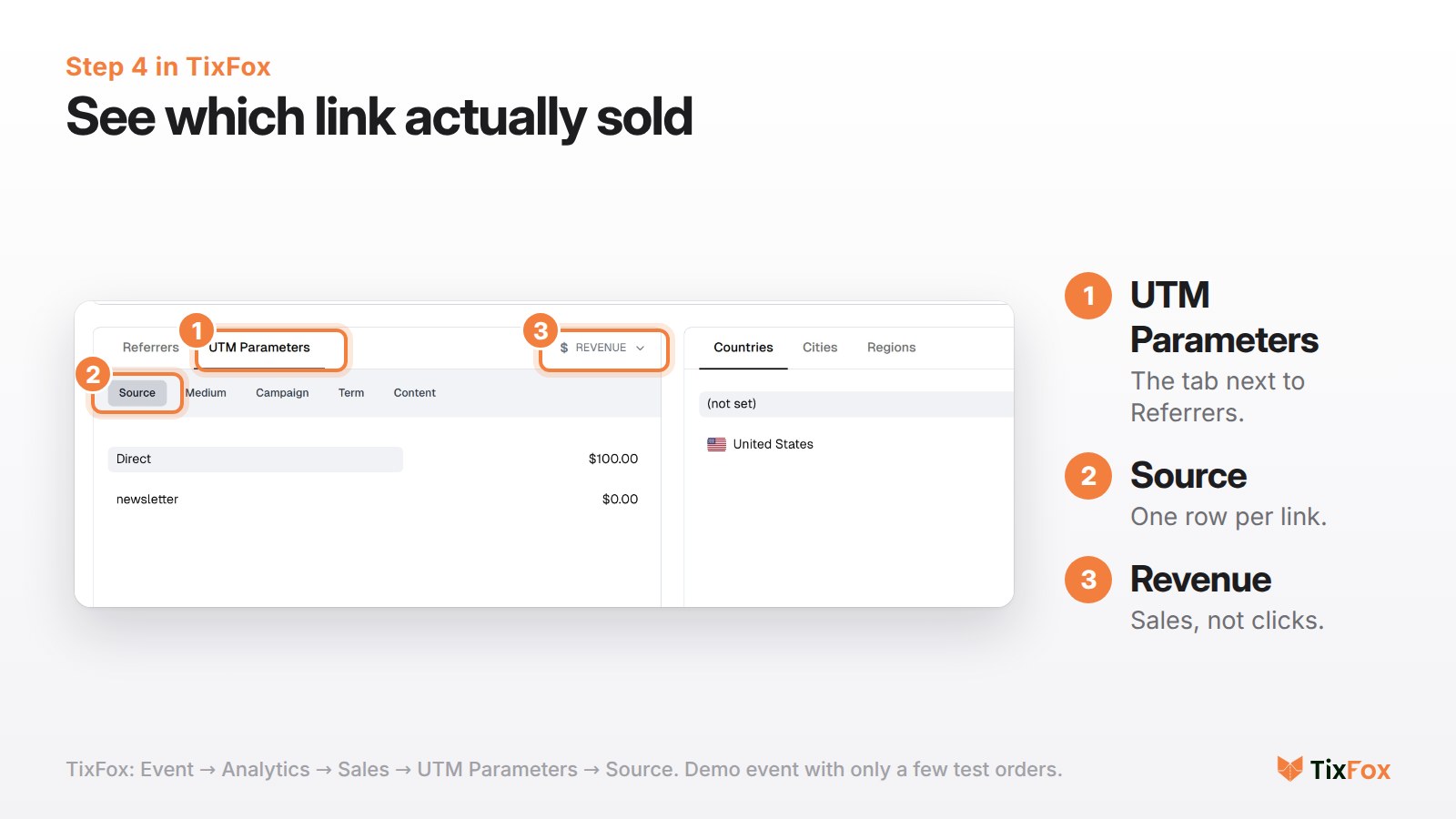
The real report in the TixFox dashboard (our demo event has only a couple of test orders).
Here's what it can reveal. In the example below, the post with 14,203 views brought in $200. The QR flyer at the coffee shop brought in $420, and the band's code sold 22 tickets.
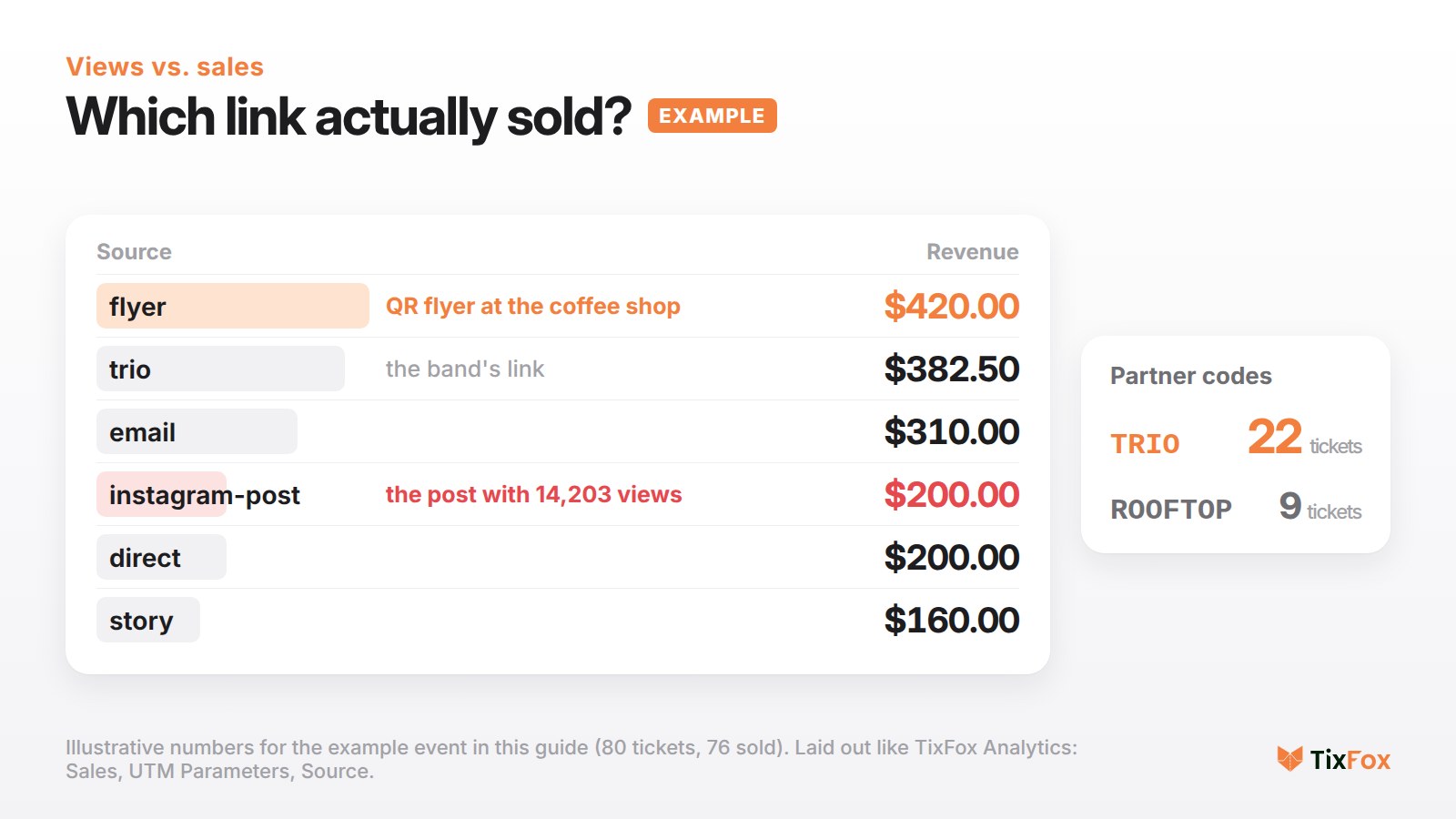
An example, not real data: the rooftop jazz night from our video.
Views aren't sales. Once you can see the difference, you stop posting into the void. In the example, the organizer prints more flyers and asks the band to post again.
Make sure buyers actually show up
A sold ticket that turns into an empty seat still costs you. The bar sells less, and a half-empty room is a worse ad for your next event than no event at all. TixFox sends automatic reminders to every buyer 7 days and 24 hours before the event, with the time, the place and their ticket.
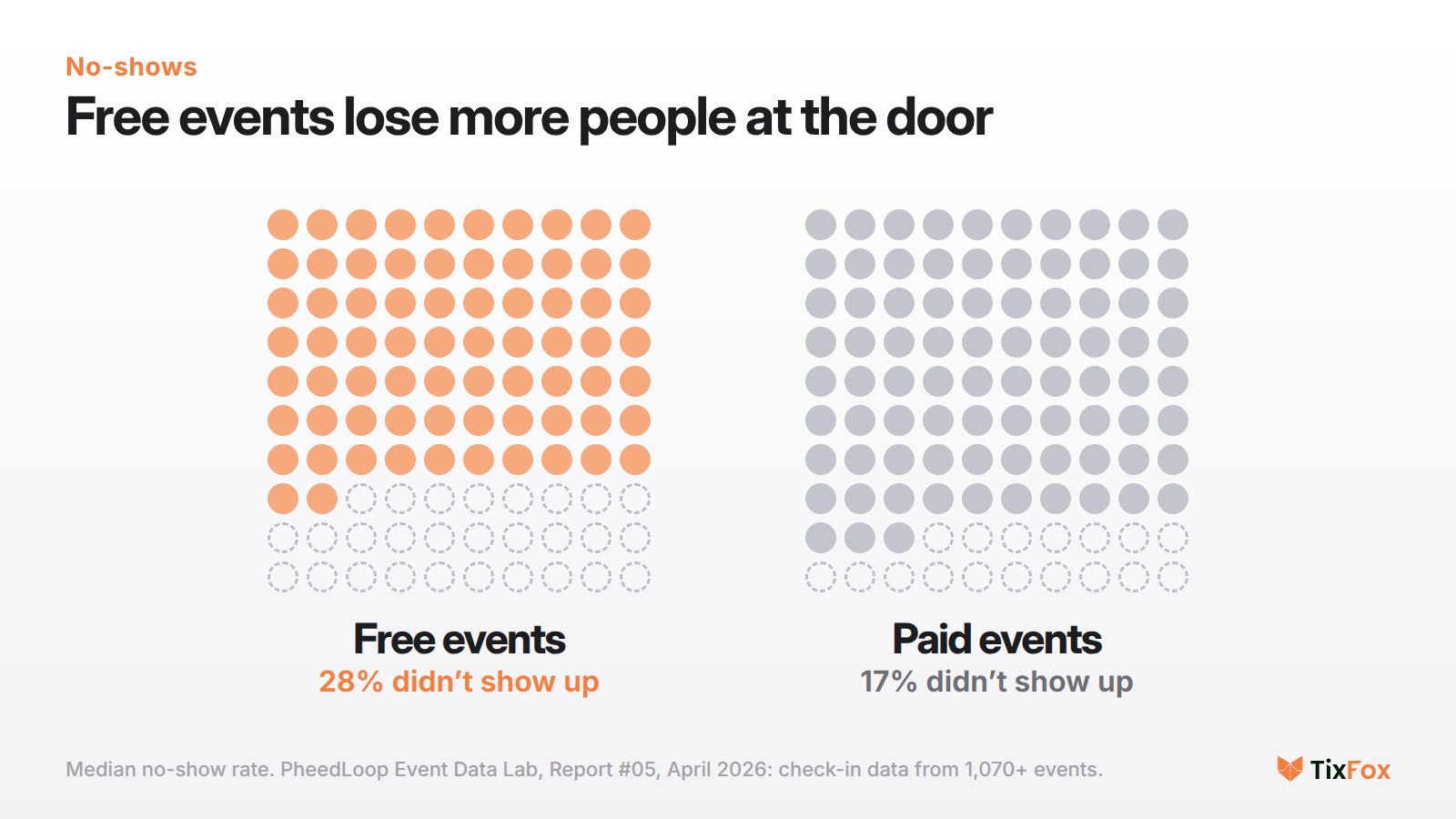
If your event is free, think about charging a little. In PheedLoop's check-in data from more than 1,070 events, free events had a median no-show rate of 28%. Paid events: 17% (PheedLoop Event Data Lab, April 2026). Even pay what you can pricing makes people commit a little more than a free RSVP does.
There's more on this in our guides to reducing event no-shows and increasing event attendance.
Mistakes that keep tickets from selling
Measuring likes instead of sales. A post can go viral and sell nothing. If you can't see sales by link, you're steering by the wrong number.
One link for everything. Then every sale looks like it came from "direct" and you learn nothing.
Early birds that never end. Extending once teaches your audience to wait for the extension.
Discounting in public at the last minute. Dropping the price for everyone with three days to go punishes the people who bought early. Send a time-boxed code to one group instead, like your email list or one partner's followers.
Going quiet in the final week. It's often your best sales week. Keep posting, with real numbers.
Counting "Interested" as attendance. The marketer above learned this the hard way. Event responses are interest, not tickets.
A worked example: a rooftop jazz night
This is the example from our video, built from the Reddit posts above. The organizer has 80 tickets at $25 for a rooftop jazz night, five weeks out. Her post has 14,203 views and 40 comments. She's sold 4 tickets.
Tickets sold at each stage (example numbers):
- Start: One post, one link, no deadline. 4 sold.
- 4 weeks out: Early bird: $20, first 30, ends Friday. 31 sold.
- 3 weeks out: Fixes the page, makes links for bio, story, email and flyer. 47 sold.
- 2 weeks out: Codes for the band and the venue, replies to every comment. 63 sold.
- Final week: "12 left," then more flyers and the band posts again. 76 sold.
The numbers are illustrative, not a promise. Your crowd, price and city will change them. What carries over is the order: deadline first, then a page that converts, then people, then a last call you can measure.
Once the plan is running, you can layer more on top, like presales, group tickets and a checkout built for phones. Our list of 9 ways organizers boost ticket sales covers those.
FAQ
How far in advance should I start selling tickets for a small event?
For most local events (gigs, comedy nights, workshops), four to six weeks is enough. Open with the early bird so the first week has a reason to buy. Bigger, pricier events like festivals or conferences need months, because people plan travel and budgets around them.
How long should an early bird ticket last?
About a week for a local event on sale four to six weeks out. Long enough for your audience to see it, short enough that waiting isn't an option. Always end it on a specific date and time, and don't extend it.
Do discounts make my event look cheap?
Not if the deadline is real. Early-bird pricing rewards people for committing early, and a partner code (10% off through a friend) feels like a perk. What does hurt is cutting the price for everyone at the last minute.
How do I know which promotion is actually selling tickets?
Give every place you share the event its own tracked link (a UTM link), and give every partner their own discount code. Then check sales by source. In TixFox, that's Analytics → Sales → UTM Parameters → Source, and redemptions per code are on the Discount Codes page.
How do I stop people from not showing up to free events?
Charge a small amount or use pay-what-you-can, send reminders a week and a day before, and ask people to add the event to their calendar when they sign up. In PheedLoop's data, paid events had a median no-show rate of 17% versus 28% for free ones.
Start your next event with a deadline that works. TixFox is free to start, and paid tickets are 39¢ each plus card processing. Free events cost $0. Early birds, tracked links, partner codes and reminders are all included. Create your event free or see the full pricing.
Sources
- Shu, S. B., & Gneezy, A. (2010). Procrastination of Enjoyable Experiences. Journal of Marketing Research, 47(5), 933 to 944. doi.org/10.1509/jmkr.47.5.933
- Nielsen (2015). Global Trust in Advertising. nielsen.com
- Flynn, F. J., & Lake, V. K. B. (2008). "If you need help, just ask." Journal of Personality and Social Psychology, 95(1), 128 to 143. doi.org/10.1037/0022-3514.95.1.128; Bohns, V. K. (2016). (Mis)Understanding Our Influence Over Others. Current Directions in Psychological Science.
- PheedLoop Event Data Lab, Report #05 (April 2026). pheedloop.com
- Federal Trade Commission. Rule on Unfair or Deceptive Fees: FAQ. ftc.gov
- r/EventProduction posts, October 2025 to October 2026, read via the Arctic Shift Reddit archive. Topic counts are keyword matches on titles and post text.