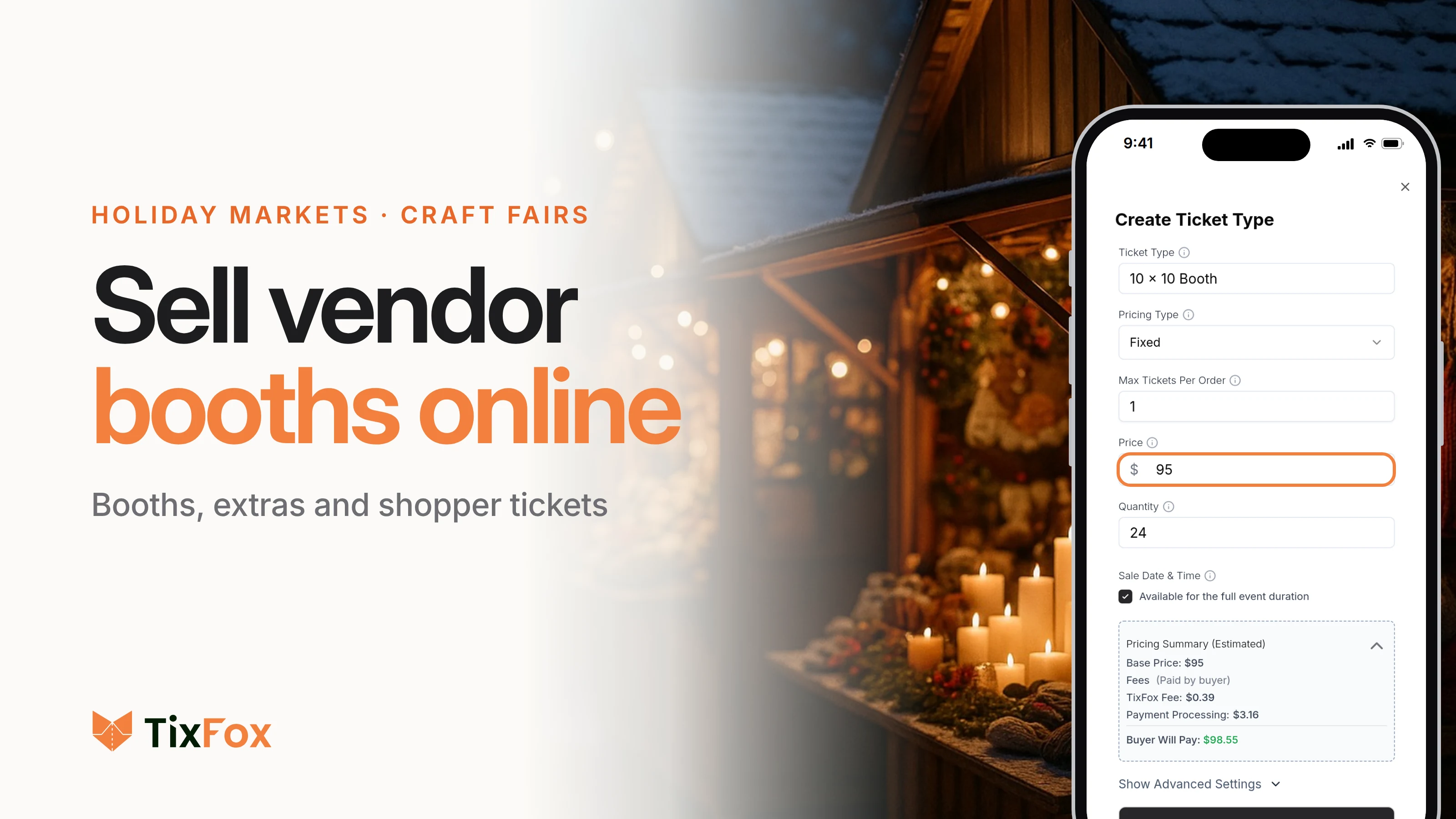
New guide, October 2026. Every TixFox step was checked in the real dashboard on October 20, 2026.
Your group chat has 41 unread messages. Three vendors say they paid on Venmo, but you can only find two payments. Someone wants a corner spot, someone else needs an outlet, and a sixth candle maker just asked if there's still room. The market is in five weeks.
This guide shows you how to organize a craft fair or holiday market without that chat, with a free vendor application you can print: how to price booths, how to take applications and payments in one place, what to ask every vendor, and how to sell shopper tickets for the same event. It uses real fee schedules from working markets and real screens from TixFox.
Quick answer: To run a holiday market, set your date and booth count, decide whether vendors apply first (juried) or simply book (open), and price booths to cover the venue, insurance and promotion. Most craft fairs charge $50 to $300 for a 10 x 10 space. Sell each booth size as its own ticket type, ask vendors your questions at checkout, sell power and tables as add-ons, publish a written refund rule, and give shoppers a free or early access ticket so you know how many are coming.
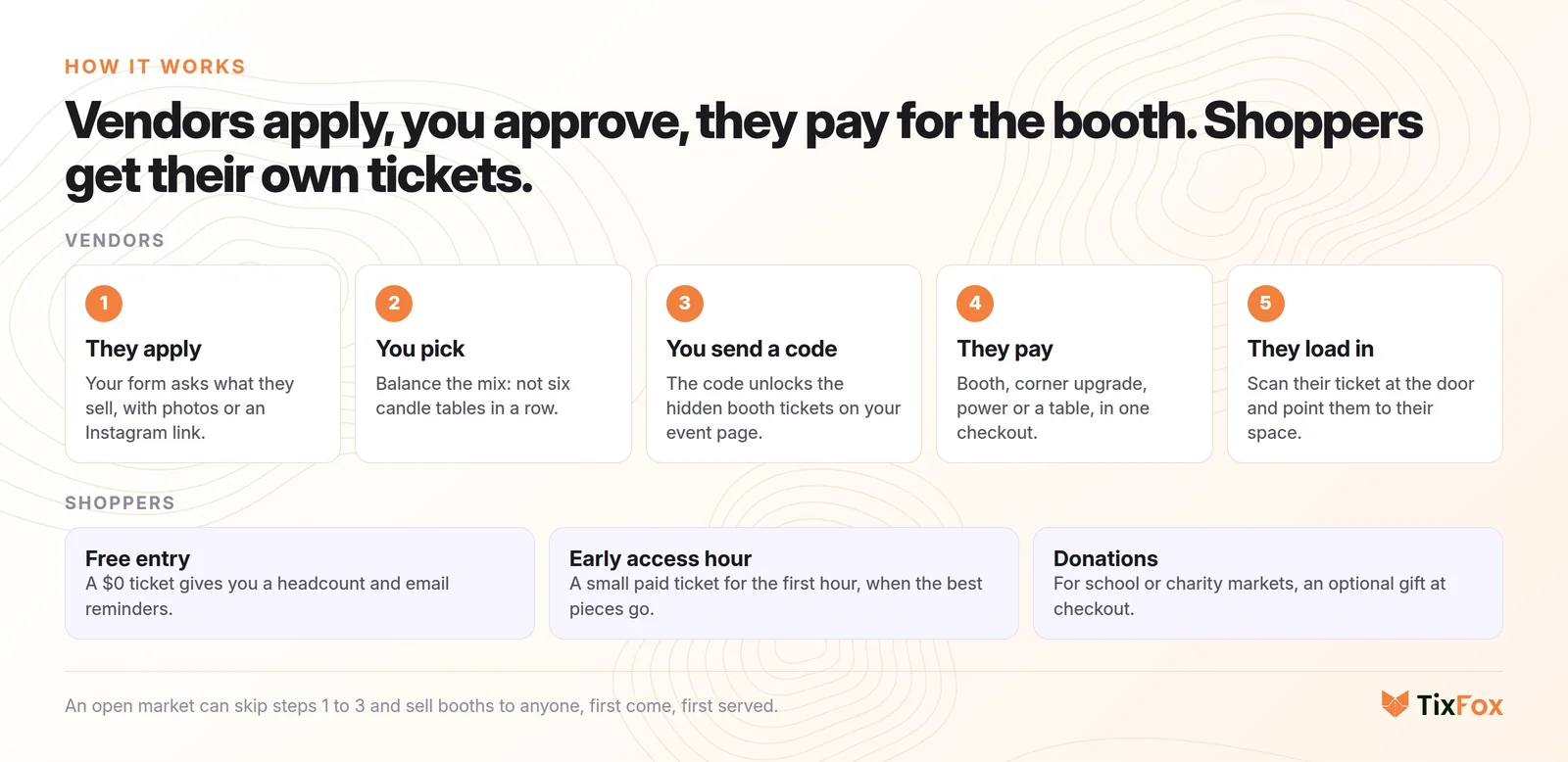
What you'll have at the end: one event page that sells booths to the vendors you approve and tickets to shoppers, with every vendor's answers in one list.
Why holiday markets get messy before they open
Most first markets collect booth fees the way friends split a dinner bill: Venmo, Zelle, cash at a meeting, a check in the mail. It works for six vendors. At thirty, you're matching payment notes to Instagram handles at midnight, and nobody can tell you who asked for electricity.
Established markets have stopped doing it. Marmion Academy's craft show in Aurora, Illinois takes every payment through its own website and says so plainly: "We also do not accept payments through PayPal, Zelle, Facebook, Venmo, or similar payment methods." The reason is simple. A booth payment should come with the vendor's name, what they sell, what they ordered and a receipt, in one place, every time.
That's what the rest of this guide sets up.
Step 1: Pick your date, size and type of market
Three decisions shape everything else.
Open or juried. An open market sells booths to anyone, first come, first served. A juried market asks vendors to apply and picks the mix, so you don't end up with six candle tables in a row. Juried markets attract stronger vendors but take more work. Nags Head, North Carolina runs a juried holiday market and says it will "balance the variety of products offered."
How many booths. Count real spaces at the venue, minus walkways and the entrance. That number becomes your booth quantity.
When to open applications. VendorsMap's organizer guide says vendors book their season 6 to 12 months out, applications should open 4 to 6 months before the event, and accepted vendors need 60 or more days to plan. If you're starting late for this December, keep it small and personally invite vendors you already know.
Step 2: Price your booths
Booth fees pay for the venue, insurance, tables, signs and promotion, and ideally leave a little over. VendorsMap looked at about 750 US and Canadian events with published booth fees (May 2026). Its medians:
- Farmers markets: $30 a booth, usually $20 to $45.
- Pop-ups: $50, usually $35 to $75.
- Festivals: $100, usually $50 to $300.
- Craft fairs: $150, usually $50 to $300.
Corner booths typically cost $25 to $50 more, and power is often an extra charge. Application fees, when markets use them, run $15 to $35. VendorsMap's advice is to skip them in your first or second year or when the booth costs under $100, because they cut the number of applications.
Here's what two real markets charge:
- Marmion Academy craft show (Aurora, IL): $150 for a 10 x 10, $175 for a corner, $20 for electricity, $10 for an 8-foot table. Shoppers pay $5 to get in.
- Nags Head Holiday Market (NC), 2025 rules: $75 for all three market days, non-refundable, paid after the vendor is accepted.
Price for your crowd, not the median. A church hall market with free entry and 300 shoppers can't charge what a juried show with 5,000 can.
Step 3: Sell each booth as a ticket type
In TixFox, a booth is a ticket type. Open your event, go to Ticket Types, and click Create Ticket. Name it after the space ("10 x 10 Booth"), set Max Tickets Per Order to 1 so each vendor books one space, set the Price, and set Quantity to the number of spaces you have. Add a second ticket type for corner booths if you charge more for them.
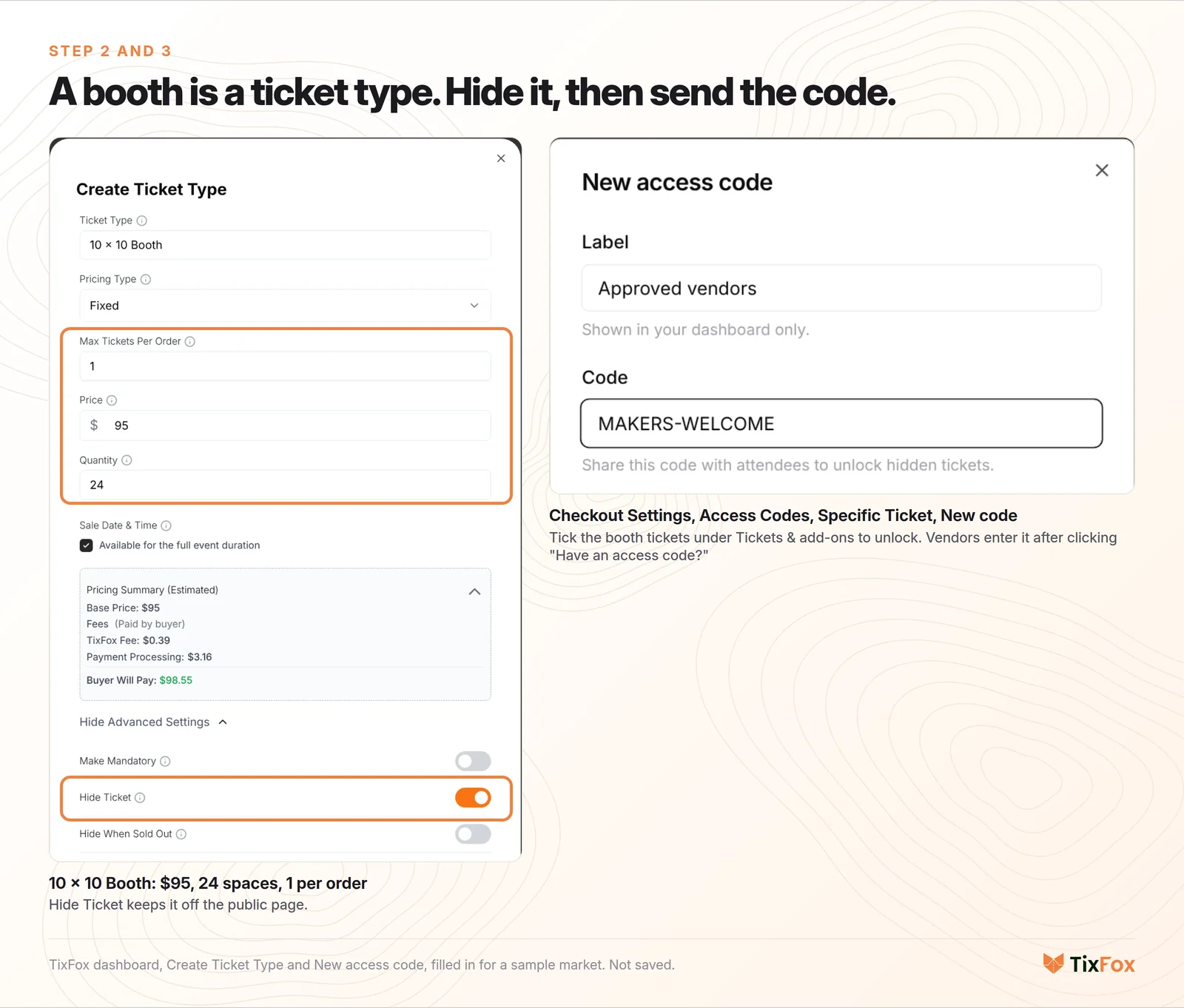
The Pricing Summary shows what the vendor pays. On a $95 booth with fees passed on, TixFox's fee is $0.39 and payment processing is $3.16, so the vendor pays $98.55 and you keep $95. You can absorb the fees instead under Handle Fees in the advanced settings.
For a juried market, add two things:
- Under Show Advanced Settings, turn on Hide Ticket. The booth stops showing on your public event page.
- Go to Checkout Settings, Access Codes, Specific Ticket and click New code. Give it a label like "Approved vendors", type a code, and tick your booth tickets under Tickets & add-ons to unlock.
Take applications however you like, with a short form or a free "application" ticket on a separate private event. When you approve a vendor, email them the event link and the code. On your event page they click Have an access code?, enter it, and the booth tickets appear. Everyone else only sees your shopper tickets.
One more trick from Marmion's playbook: it gives returning crafters the first window to rebook. You can do the same by sending last year's vendors their code a few weeks before anyone else, and setting your booth tickets' sale dates so the window closes when you want it to.
Step 4: Ask every vendor what you need for the floor plan
Every order already asks for first name, last name and email. Add the rest under Custom Fields: the business name for the sign above their table, an Instagram or website so you can check their work, and what they sell, as a dropdown so the answers come back in the same words.
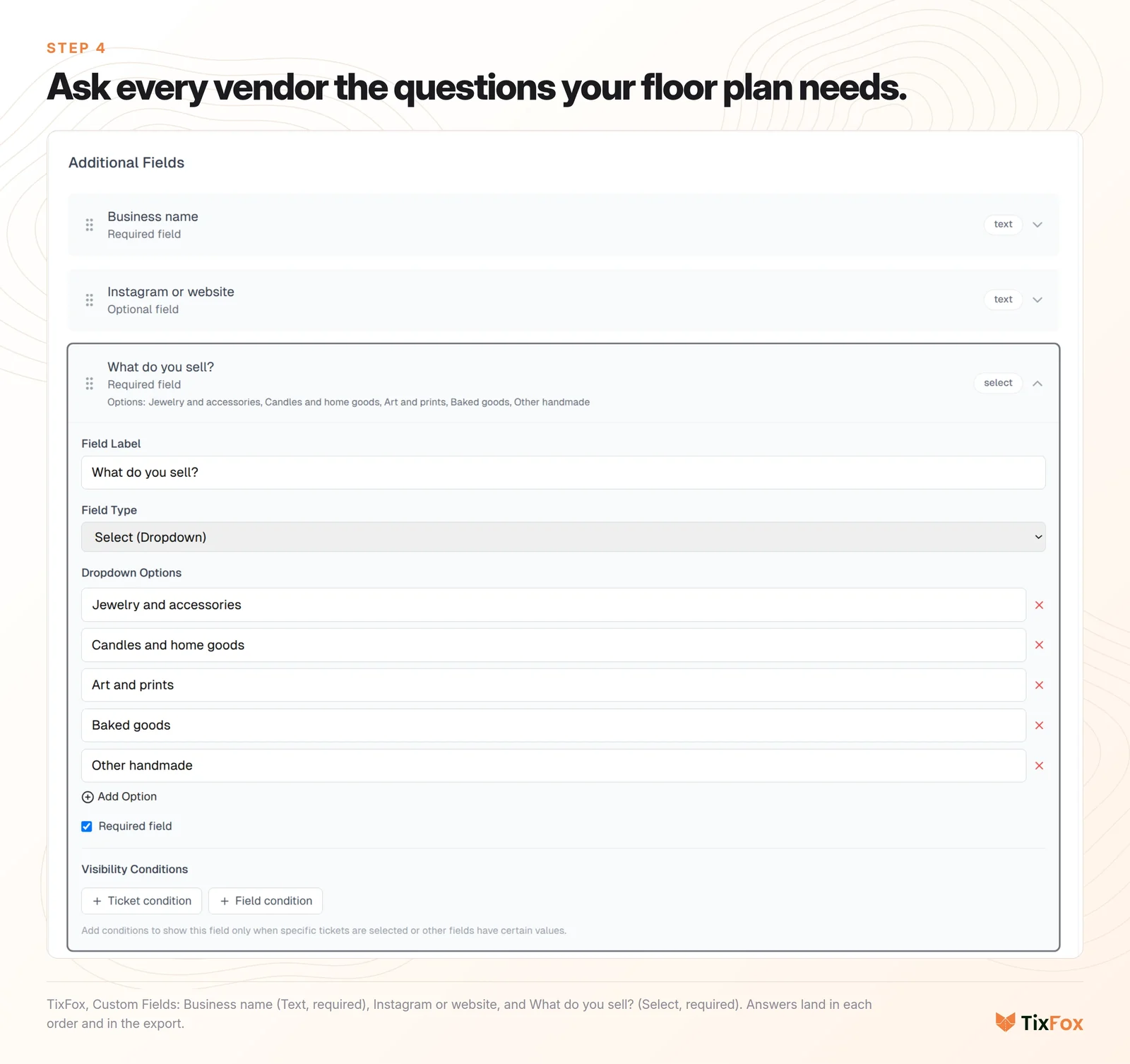
Use Visibility Conditions, then Ticket condition, to show these questions only when someone picks a booth ticket. Shoppers buying an entry ticket won't see them.
Good vendor questions to consider: whether they'll bring their own tent or table, whether they need power, whether they sell food (which usually brings a health permit), and an emergency phone number for market day. Answers sit in each order under Additional Information and come out in the CSV export. If you're using TixFox already, the custom fields feature walks through every question type.
Free craft fair vendor application template (PDF)
Download the vendor application (PDF): one page, US Letter, free to print and hand out or email. It asks for the business, what they sell, whether it's handmade, food permits, the booth and extras they want, a box for your rules and refund policy, a signature, and an office-use strip for approval, booth number and payment.
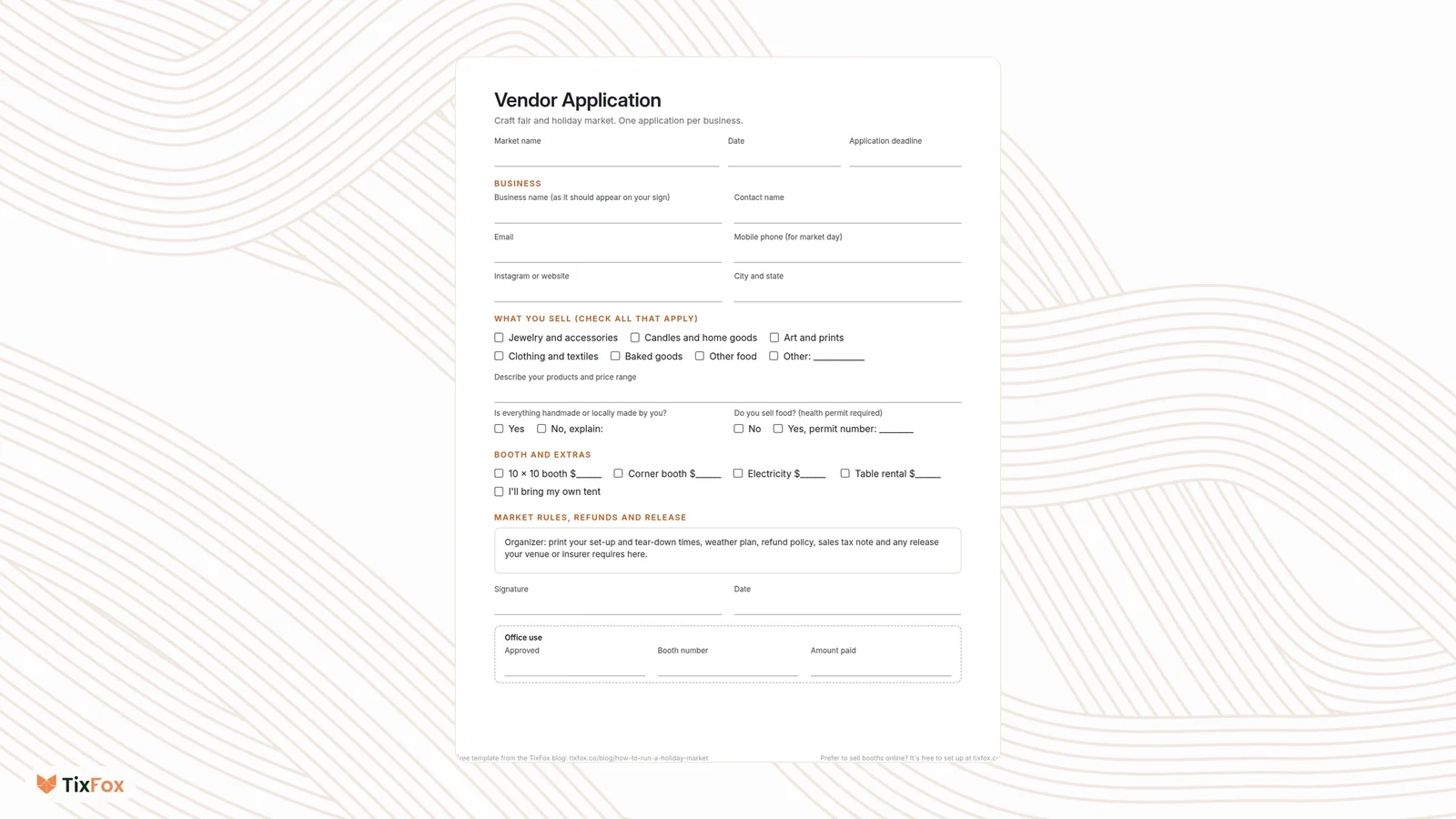
Taking applications online? Ask the same questions. Name and email come with every TixFox order; add the rest as custom fields:
- Name and email (every order asks these).
- Business name, as it should appear on the booth sign (Text, required).
- What do you sell? (dropdown, required): your categories, so you can balance the mix.
- Instagram or website (Text), so you can see their work.
- Mobile number for market day (Phone).
- Do you need electricity? Better as an add-on with a limited quantity, so it's paid for and can't oversell.
- Will you bring your own tent or table? (Radio Group).
- Do you sell food? (Radio Group). If yes, ask for their health permit before the market.
- "I agree to the vendor rules and refund policy" (Checkbox Group, required).
Step 5: Sell the extras, then sell to shoppers
Electricity, tables, chairs and corner upgrades are add-ons. Go to Add-ons, click Create Add-on, and set a price and a quantity. Set the quantity to the number of outlets you really have, so power can't oversell. The add-ons feature covers the details.
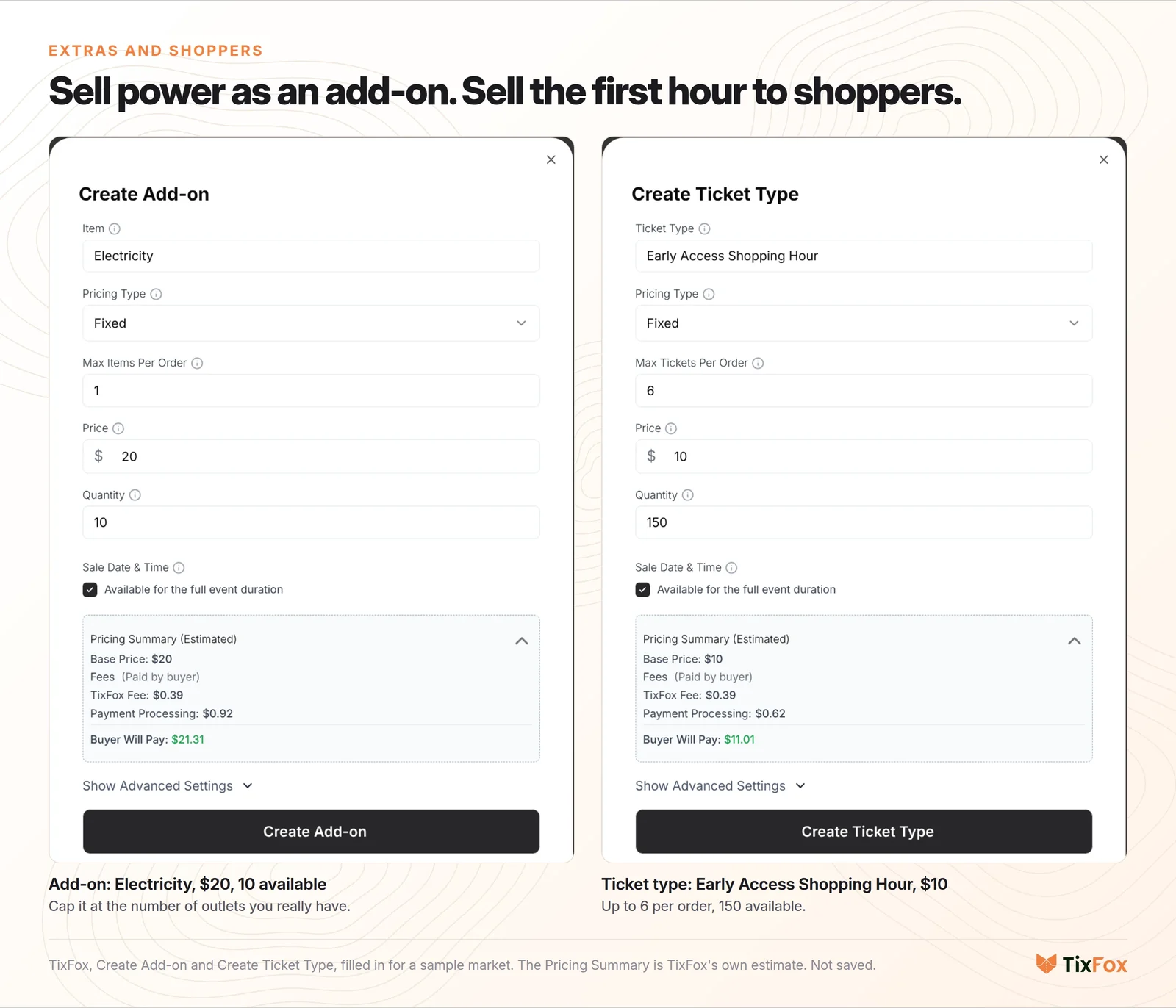
Now the shopper side. Even a free market gains from tickets:
- A free General Admission ticket gives you a headcount, an email list for next year, and automatic reminder emails 7 days and 24 hours before the market. Free tickets carry no TixFox fee.
- An early access hour sells the first hour, when the best pieces go. Vendors like it because those buyers come to spend.
- A preview night turns the evening before into its own event.
The Junior League of Tampa's Holiday Gift Market is a good model for how far this can go. Its 2026 market sells an early bird general admission ticket for $10, general admission for $12, a Preview Night for $30 and a VIP Preview Party for $100, and the league says 100% of net proceeds fund its community projects.
If your market raises money for a school, a church or a charity, turn on Donations under Checkout Settings so shoppers can add a gift at checkout (donations).
Step 6: Write the rules before the first booth sells
Vendors argue about rules they never saw. Put them in writing before you open, and put the refund rule where every vendor will read it. In TixFox, go to Checkout Settings, Refund Policy and type it in. It's shown on your event page.
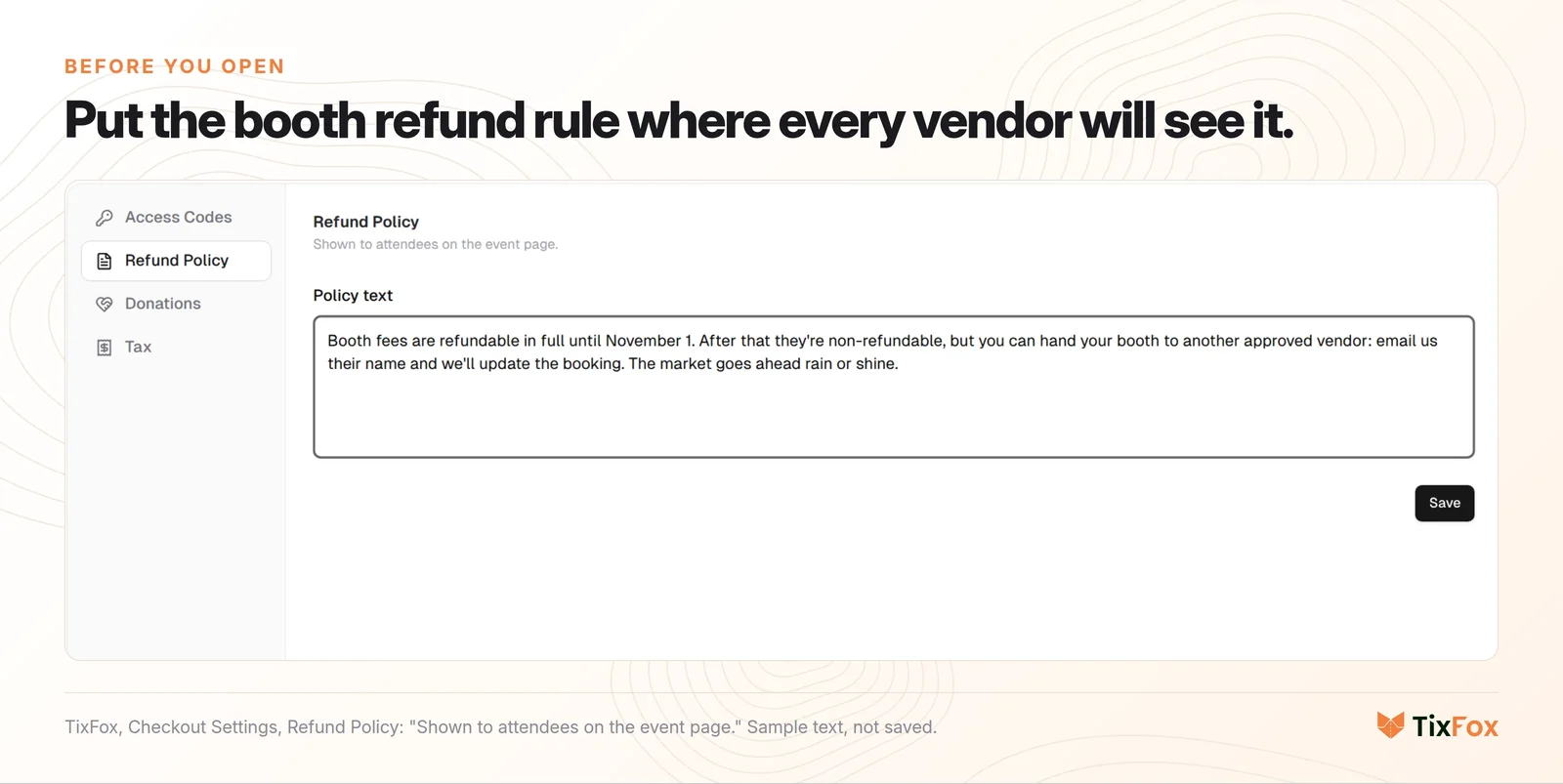
VendorsMap sees three common refund rules:
- Standard: full refund 60 or more days out, 50% at 30 to 60 days, nothing inside 30 days.
- Strict: no refunds once paid, common at juried shows with a waiting list.
- Lenient: a full refund up to 14 days out, common at first-year markets.
Pick one and use it every time. Then cover the rest: set-up and tear-down times, the weather plan ("rain or shine", as Nags Head puts it), whether vendors must stay open the whole time, and booth sharing. For more on writing a policy people accept, see our guide to event refund policies.
Two things are usually the vendor's job, not yours, but say so in your rules. Sales tax is normally collected and paid by each vendor. In California, sellers at swap meets, flea markets and special events must give the event's operator information about their seller's permit, and the state's tax agency has a form for it (CDTFA-410-D). Check your own state's rules. And ask about insurance early: VendorsMap recommends general liability cover of at least $1 million for the market itself, and many venues require proof.
Step 7: Run market day from your phone
Every booth and shopper ticket arrives by email with a QR code. On the day:
- Load-in: scan each vendor's booth ticket as they arrive, so you know who's missing before doors open. Add volunteers as check-in assistants; they can scan tickets for your event and nothing else.
- Floor plan and signs: go to Orders and click Export. You get every vendor's name, email, booth type and answers in one CSV, ready for a layout sheet or name cards.
- Load-in details: edit the order confirmation email in your event's Communication tab to include parking, load-in times and where to unload, so every vendor gets them the moment they book.
- The door: scan shopper tickets at the entrance. Walk-ins can buy on the spot.
What it costs to sell booths online
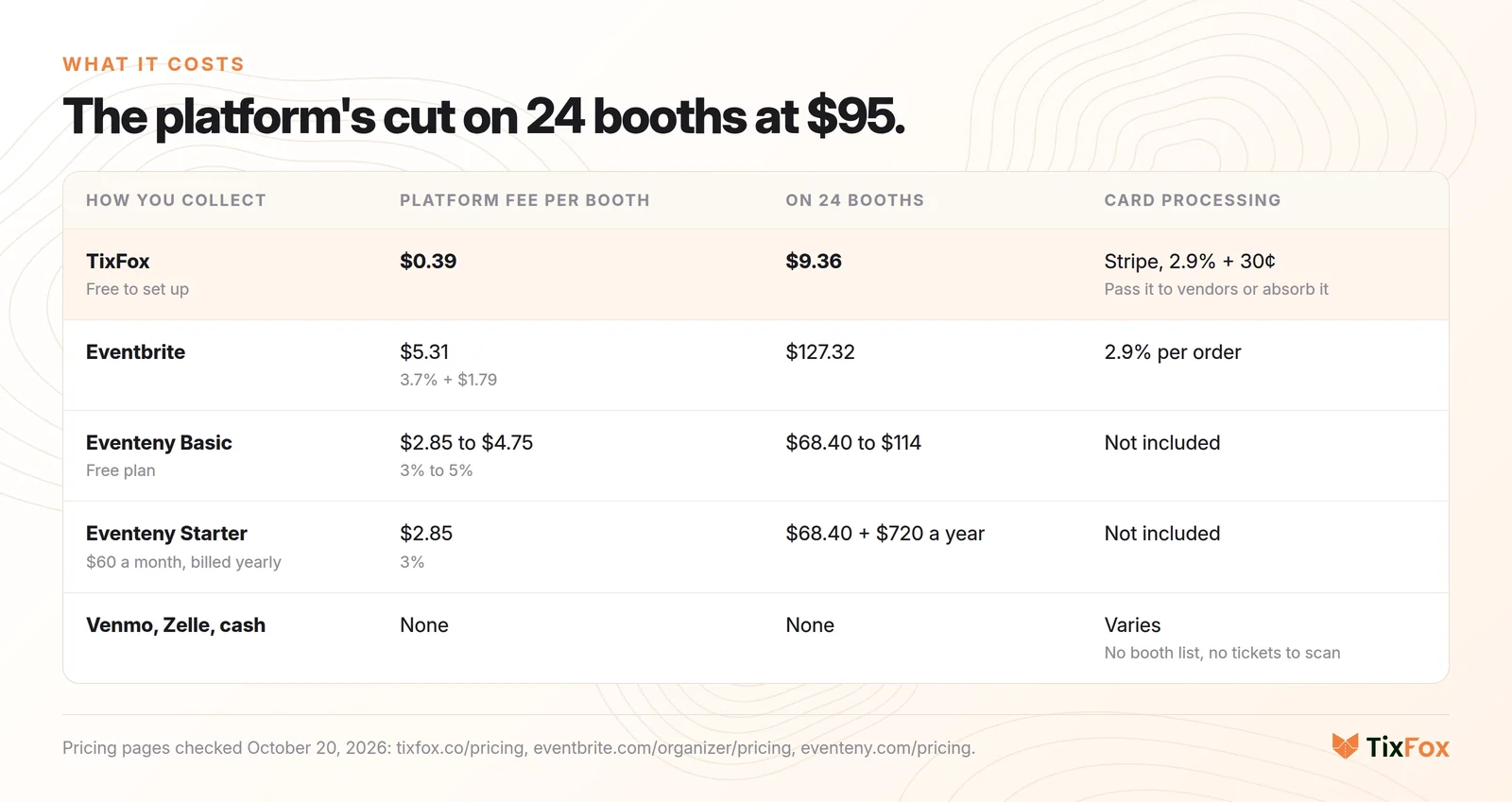
TixFox is free to set up and charges $0.39 per paid ticket or add-on ($0.30 under $5), plus Stripe's card processing of 2.9% + 30¢. On 24 booths at $95, that's $9.36 in TixFox fees for the whole market, and you can pass them to vendors or absorb them. See TixFox pricing.
Opening applications soon? Create your market on TixFox and set up your first booth ticket. Free to set up, 39¢ a booth.
TixFox, Eventeny or a form and Venmo?
All three can work, and the right one depends on the market.
A form and Venmo costs nothing in platform fees and is fine for a handful of vendors you know. It stops working when you need one list of who paid for what, receipts, refunds and a way to check vendors in.
Eventeny is built for vendor management. Its plans include applicant decision workflows and insurance certificate checks, which matter for large juried shows with hundreds of applicants. Its free Basic plan charges 3% to 5% per transaction, and paid plans start at $60 a month billed yearly, with card fees on top.
TixFox fits markets that want to sell booths, extras and shopper tickets on one page for the lowest fee per booth. It doesn't have a built-in approve or decline step, so juried markets use the hidden booth ticket and access code from Step 3.
Mistakes that cost organizers vendors
- Opening booths before writing the rules. The first refund request becomes an argument. Publish the policy first.
- Taking payment before you've chosen the mix. In a juried market, approve first and send the code after, as Nags Head does with its invoices.
- Unlimited power. Ten outlets means ten electricity add-ons. Set the quantity.
- No vendor questions. Without business names and categories, you'll be making the floor plan from DMs.
- Treating shoppers as an afterthought. A sold-out vendor hall with no shoppers loses you next year's vendors. Start promoting six to eight weeks out, and give shoppers a reason to come early.
- Two bookings, one email. Keep Max Tickets Per Order at 1 for booths, so every booth has its own vendor and contact.
How we tested this
We set up a sample holiday market in TixFox's real dashboard on October 20, 2026, using our demo account: a $95 booth ticket with 24 spaces, the Hide Ticket switch, an access code for approved vendors, three vendor questions, a $20 electricity add-on, a $10 early access ticket and a refund policy. The screenshots show those forms filled in. We didn't publish the market, so the booth names, prices and code are examples.
The fee schedules come from the markets' own pages, and the booth fee medians come from VendorsMap's published data. Platform prices are from each company's pricing page on October 20, 2026.
FAQ
Is there a free craft fair vendor application template?
Yes. This guide has a free one-page vendor application as a printable PDF. It covers the business, what they sell, handmade and food questions, booth size and extras, your rules and a signature. Use the same questions if vendors apply or book online.
How much should I charge vendors for a booth at a craft fair?
Most craft fairs charge $50 to $300 for a 10 x 10 space, and VendorsMap's median is $150. Small church and school markets often charge less, and corner spots usually cost $25 to $50 more. Start from your costs: venue, insurance, tables and promotion, divided by your number of booths.
Should I charge an application fee?
Usually not in your first two years. Application fees of $15 to $35 are common at juried shows, but VendorsMap says they cut applications by 50% to 70%. If you do charge one, say clearly that it isn't refunded if the vendor isn't accepted.
How do I collect vendor fees without Venmo?
Sell each booth as a ticket type on your event page. Vendors pay by card, get a receipt and a QR code, and you get their name, email and answers in one list. For a juried market, hide the booth tickets and send approved vendors an access code.
Should shoppers pay to get into a holiday market?
Many small markets keep entry free and earn from booth fees. Larger ones charge a few dollars, like Marmion's $5, or sell an early access hour or preview night. A free ticket still helps: it gives you a headcount and sends shoppers reminders.
What permits do I need for a holiday market?
It depends on your city and state. Ask the venue and your town clerk about event permits, and check food permits if anyone sells food. Vendors usually handle their own sales tax, and some states, like California, require vendors to give the organizer information about their seller's permit.
How far ahead should I plan a craft fair?
Four to six months for a new fair is comfortable: open applications then, give accepted vendors at least 60 days, and start promoting to shoppers six to eight weeks out.
Open your booths with one link
Your venue is booked and the vendors are out there. Put the booths, the extras, the rules and the shopper tickets on one event page, and the group chat can go back to being a group chat.
Create your market on TixFox. It's free to set up, and booths cost 39¢ each.
Sources
- Marmion Academy craft show: booth sizes and prices, corner booths, tables, electricity, shopper admission, returning crafter dates, no Venmo, Zelle or PayPal.
- Town of Nags Head Holiday Market rules: payment after acceptance, selection priority, product balance, $75 fee for three markets, rain or shine.
- VendorsMap: how to set booth fees, May 4, 2026: medians by event type from about 750 events, application fees, corner and power premiums, refund patterns.
- VendorsMap: how to organize a craft fair: timeline, insurance and permits, sales tax.
- The 2026 Junior League of Tampa Holiday Gift Market: shopper ticket tiers and proceeds.
- CDTFA: Temporary Sellers: sellers at special events and form CDTFA-410-D.
- Eventeny pricing and Eventbrite pricing, checked October 20, 2026.
- TixFox dashboard, demo account, October 20, 2026: Create Ticket Type (Max Tickets Per Order, Quantity, Pricing Summary, Hide Ticket), Access Codes, Custom Fields and Visibility Conditions, Create Add-on, Refund Policy, Donations. Fees from tixfox.co/pricing.
Written by the TixFox team. We build ticketing for organizers of every size, and we set up every TixFox step in this guide ourselves.
Keep more of every ticket sale.
- 39¢ per ticket, $0 on free events
- No monthly fee, no contract
- Get paid as each sale comes in