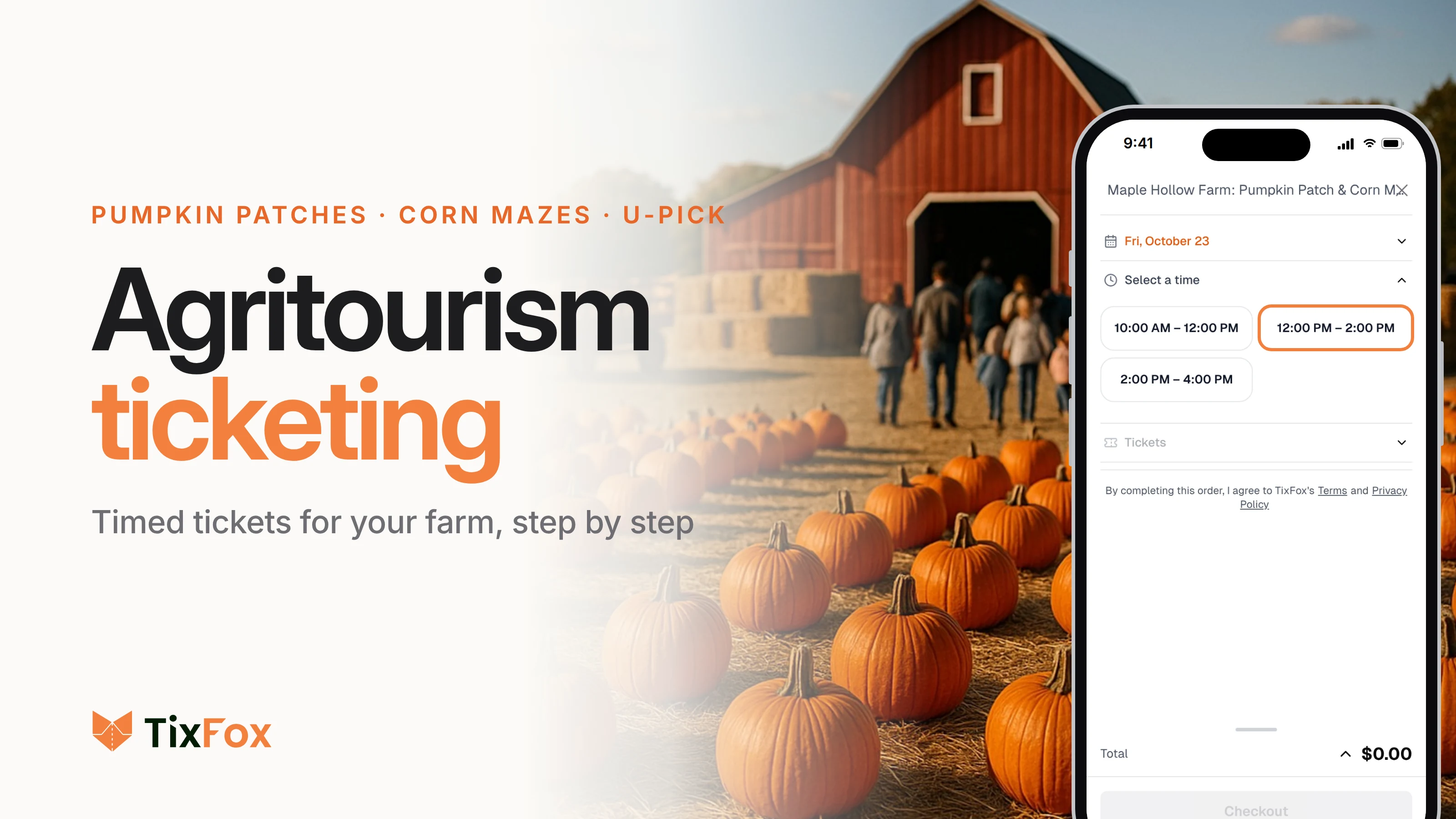
New guide, October 2026: how pumpkin patches, corn mazes and u-pick farms sell timed tickets, with real numbers and real screens. Checked October 17, 2026.
Quick answer
Agritourism ticketing means selling entry to your farm online, usually as timed tickets: the visitor picks a day and a two-hour arrival window, pays, and gets a QR code that you scan at the gate. To set it up, decide what admission includes, cap each window by what your parking lot can hold, price quiet days lower than weekends, write your weather rule before the first sale, add the extras people already buy at the farm, and keep a few spots for walk-ups.
- Windows: two-hour arrival windows, for example 10 to 12, 12 to 2 and 2 to 4. Once people are in, they stay as long as they like.
- Cap: parking spaces × people per car × (window length ÷ average stay). Count your own numbers on a busy Saturday.
- Price: the farms we checked charge $4 to $9 more on weekends. Bob's Corn charges $19.95 on weekdays and $28.95 on weekends.
- Weather: say what happens if you close, at the top of the page, before anyone buys.
- Cost on TixFox: 39¢ a ticket plus Stripe's 2.9% + 30¢. A family of four with a pumpkin voucher pays $70.29 on a $66 order, and the farm keeps $66.
It's the second Saturday in October. By eleven, cars are backed up past your mailbox and onto the county road. The corn maze is a conga line. The hay wagon has a forty-minute wait, the donut stand ran out of cider, and the family that drove an hour turns around at the end of your lane. Then Tuesday comes, and you have nine visitors.
Timed tickets fix most of that. The busy day gets spread out, the quiet days get a reason to come, and you know on Thursday night how many people are coming on Saturday. This guide walks through how to set it up so it helps your visitors instead of getting in their way.
Why farms are moving to timed tickets
Agritourism is real money now. US farms and ranches earned $1.26 billion from agritourism in 2022, up 12.4% from 2017 after inflation, and about 57% of US counties reported some, according to the USDA's Economic Research Service.
Selling ahead is how the busiest farms keep weekends under control. The University of Kentucky's Center for Crop Diversification says advance tickets with entry windows "could smooth arrivals, reduce parking chaos, and reduce wait times", and that they help you plan staff, collect a waiver, and get every visitor's email for directions and reminders. Bob's Corn & Pumpkin Festival in Snohomish, Washington, goes further: tickets on October weekends are online only, "No exceptions", and on other days a ticket bought at the gate costs $5 more.
There's a catch, and it matters. A January 2026 piece in Agritourism Today warns that complicated ticketing keeps people away: forced date pickers, too many questions, unclear prices, and policies hidden at the bottom of the page. Its line on that last one: "ambiguity is a major cause of ticketing abandonment." So the goal isn't just to sell online. It's to make buying a ticket feel as easy as pulling into your lot.
Step 1: Decide what admission includes
Before you set a price, write down what a ticket gets someone and what costs extra. Visitors get annoyed when they find out at the corn maze entrance that the corn maze wasn't included.
A simple split that works for most farms:
- Included: the corn maze, the hayride, the barnyard animals, the play area, the photo spots.
- Extra: pumpkins (by size or weight), food, cider and donuts, goat feed, gem mining, a second maze at night.
- Free: the youngest kids (Bob's Corn charges from age 2), and the farm store. Let people shop without a ticket if you can.
Put that list at the top of your event page in plain words. It answers the question most buyers have before they press anything.
Step 2: Size each arrival window from your parking lot
It's tempting to guess the cap for each window. Start from the thing that actually runs out first on a busy day, which is usually parking, not the field.
A rule of thumb:
Visitors per window = parking spaces × people per car × (window length ÷ average stay)
Say your grass lot holds 85 cars, families arrive about 3.5 to a car, and people stay about two and a half hours. With two-hour windows, that's 85 × 3.5 × (2 ÷ 2.5) = 238, so about 240 visitors per window. Count your own numbers on a busy Saturday: cars at the peak, people in twenty cars, and how long a few families stay.
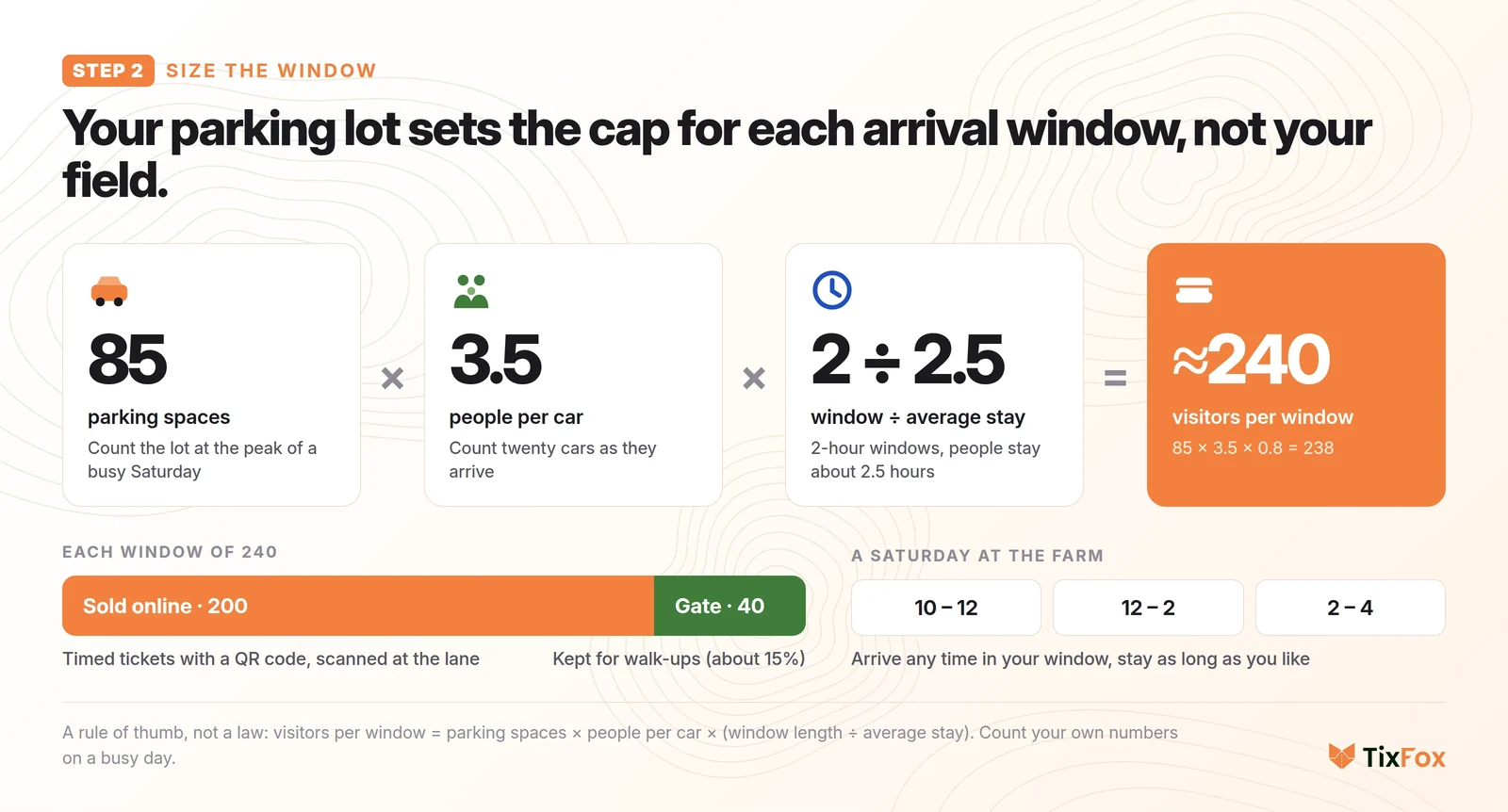
Then keep a slice of each window back for the gate. About 15% is a good start, and step 8 covers why.
Step 3: Price quiet days lower than weekends
Weekends sell themselves. Weekdays need a reason. Farms that sell timed tickets often charge less on quiet days and more on October weekends:
- Bob's Corn (Snohomish, Washington): $19.95 on weekdays, $28.95 on weekends, $2 off in September, $5 more at the gate.
- Tanaka Farms (Irvine, California): $23 on weekdays and $27 on weekends, timed entry bought in advance, per NBC Los Angeles.
Across the farms we checked, the gap was $4 to $9. It moves families who can come on a Friday afternoon to the Friday afternoon, which is the whole point. If you want the math for your own costs, our guide on how to price event tickets walks through it.
One trick that saves time in any ticketing tool: set the base price at your busy-day price, and only change the quiet slots. There are fewer of them.
Step 4: Set up the dates and windows once
Here's how that looks in TixFox, on a demo farm we set up for this guide.
- Create the event as a recurring event. Title, a short description with the "included / extra" list, a photo, and your address.
- Add the ticket types. "Admission, ages 13+" at $20 and "Child, ages 3 to 12" at $15. The quantity is per time slot, so 120 each means up to 240 people in one window.
- Generate the dates. Occurrences, then Generate dates: weekly, on Friday, Saturday and Sunday, from October 23 to November 1, with three time slots: 10 to 12, 12 to 2 and 2 to 4. TixFox makes all 18 windows in one go.
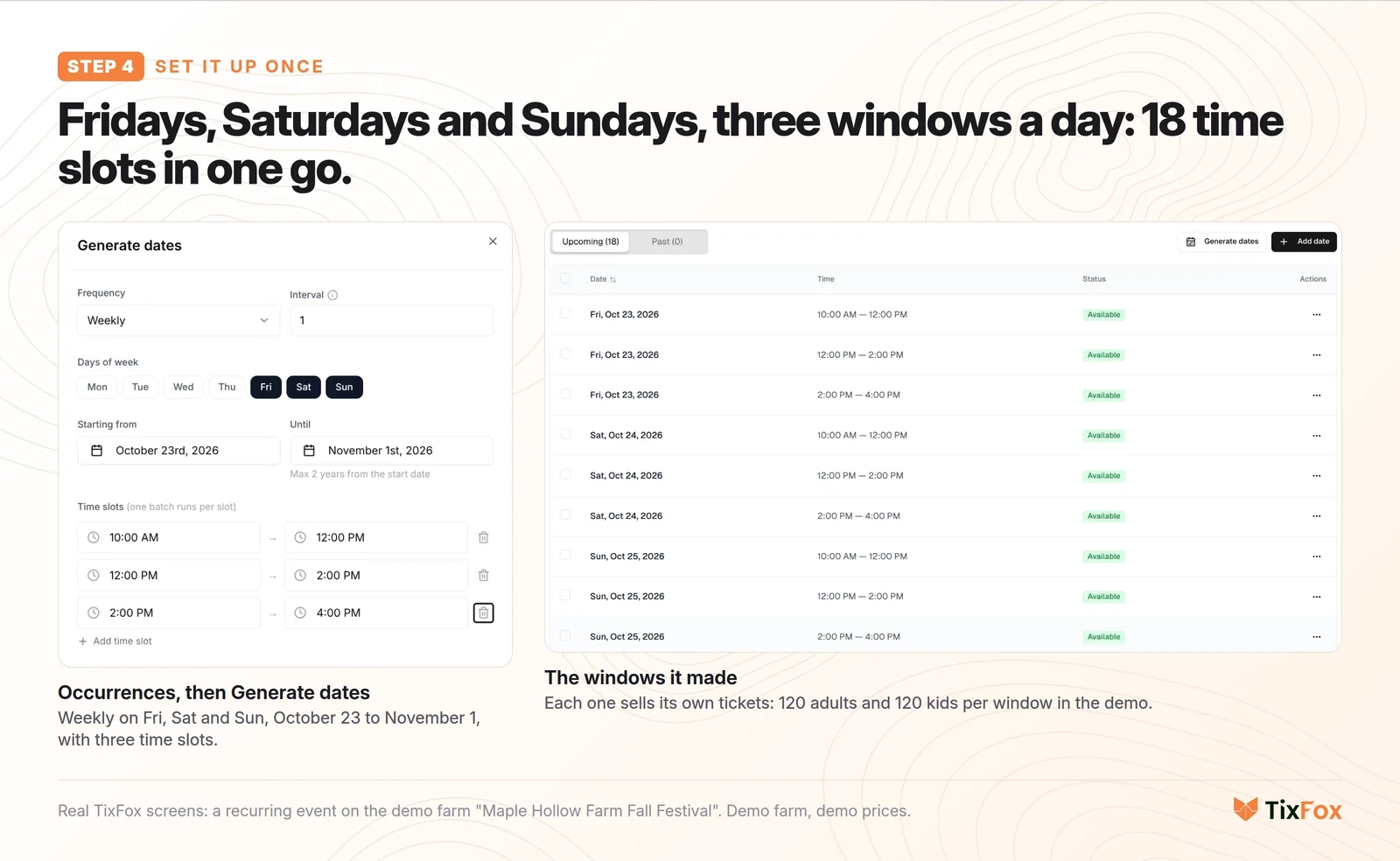
Then make Fridays cheaper. Occurrences, then Overrides, then Add override: pick the ticket, pick the Friday window, and type the lower price. In the demo, Friday is $16 for adults and $12 for kids. On the buyer's phone, Friday shows $16 and Saturday shows $20, with nothing extra to explain.
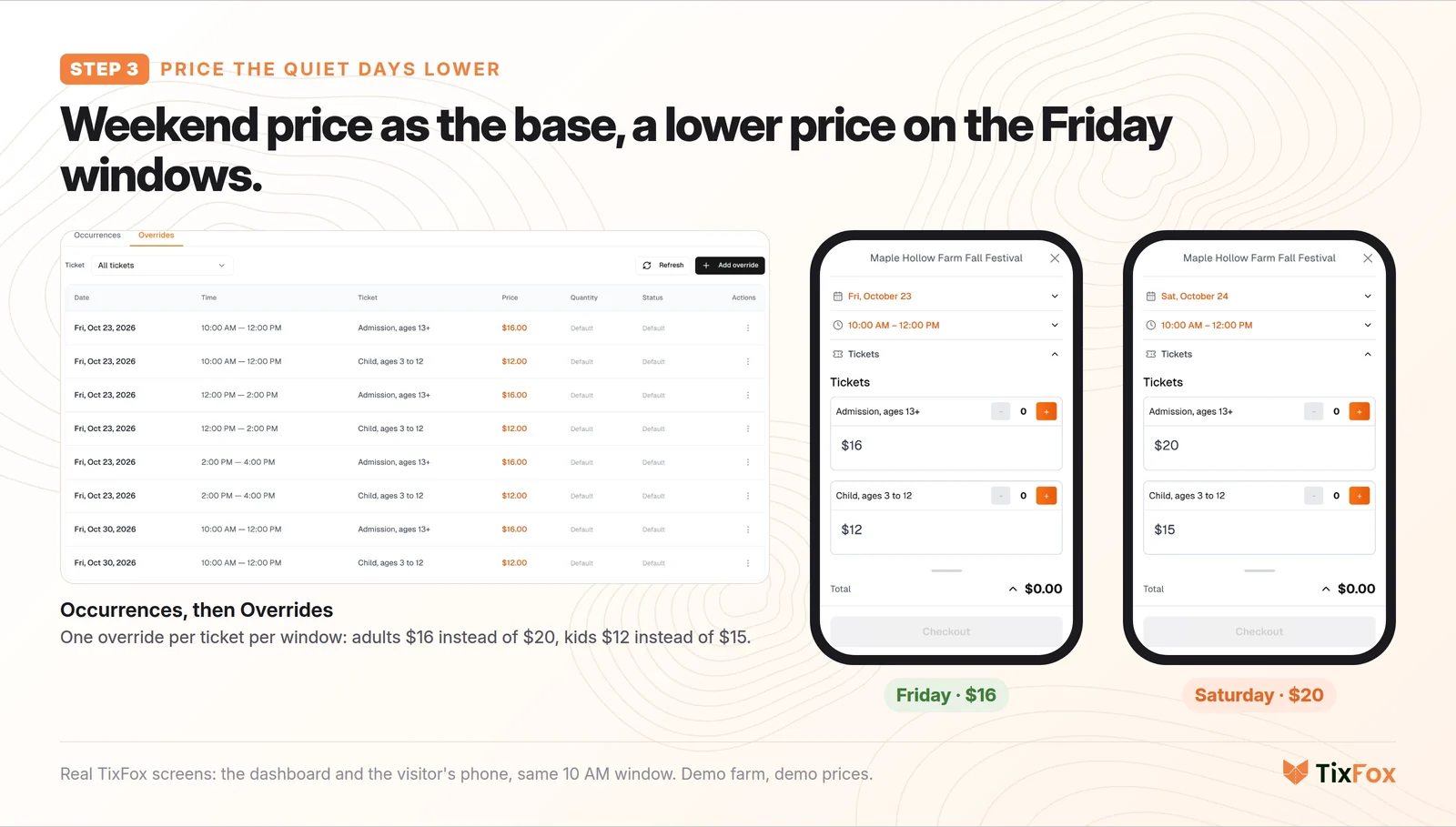
On the buyer's side it's three taps: a day on the calendar, an arrival window, then tickets. Agritourism Today counts a date and time picker as a barrier, if often a necessary one, so keep it to one calendar and one tap.
Set up your farm's season: create a free TixFox account, generate your weekends in one go, and share one link. Free to set up, 39¢ a ticket.
Step 5: Write the weather rule before you sell
Every farm gets a washout. The question is whether your visitors find out what happens before they buy or after it rains.
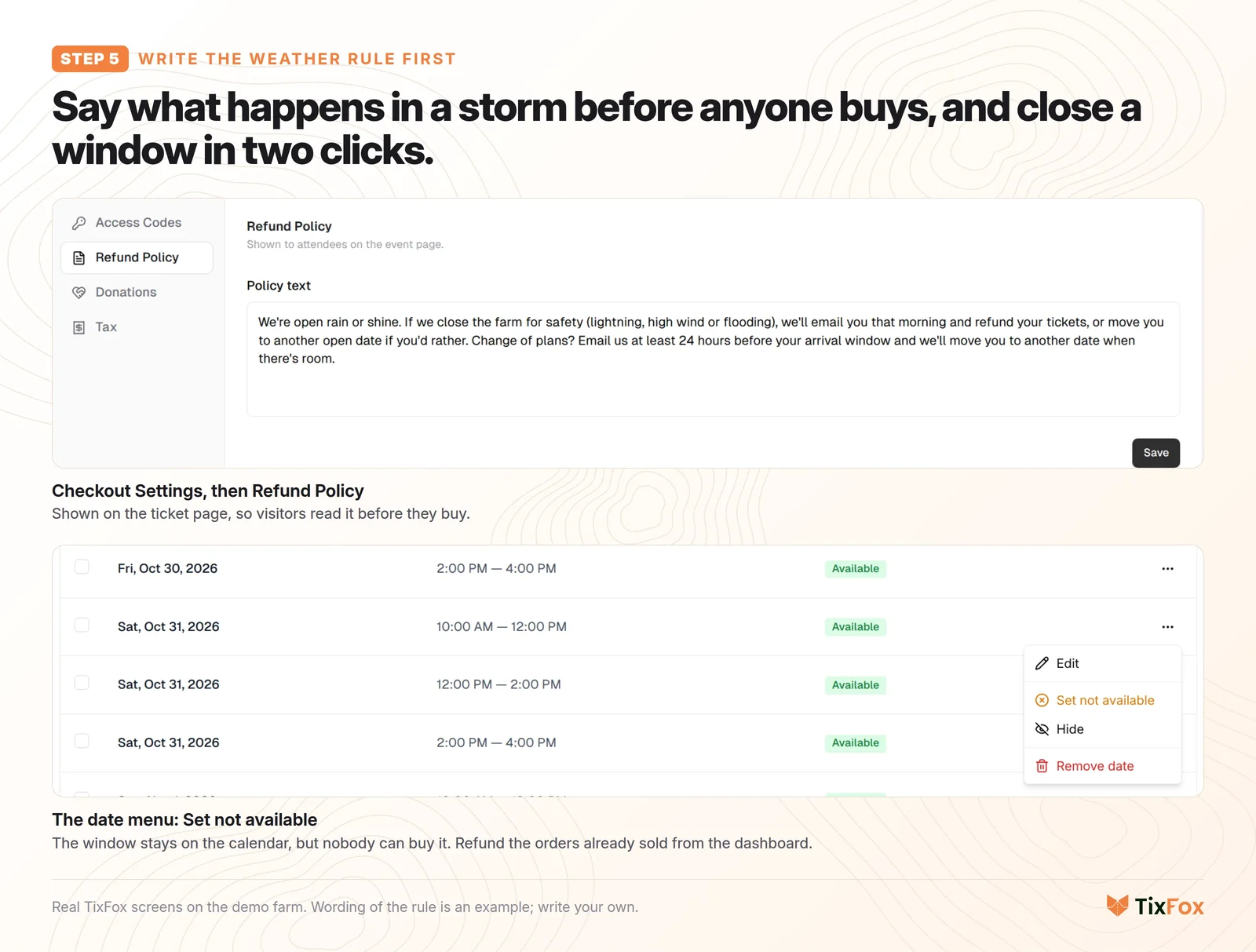
Write it in two sentences and put it near the top of your page, where Agritourism Today says it belongs. The Kentucky extension makes the same point: spell out your refund, transfer and weather plan before people buy. Here's the one on the demo farm, saved as the event's Refund Policy so it shows on the ticket page:
"We're open rain or shine. If we close the farm for safety (lightning, high wind or flooding), we'll email you that morning and refund your tickets, or move you to another open date if you'd rather."
When the forecast turns, close the affected windows so nobody else buys. In TixFox, each date's menu has Set not available, Hide and Remove date. Set not available keeps the window on the calendar but stops anyone buying it, and you can refund the orders already sold from the dashboard. If you want more wording ideas, our event refund policy templates include a weather clause for outdoor events.
Step 6: Sell what people already buy at the farm
Families spend money at the farm anyway. Letting them add it to the ticket means less cash at the stand and a shorter line.
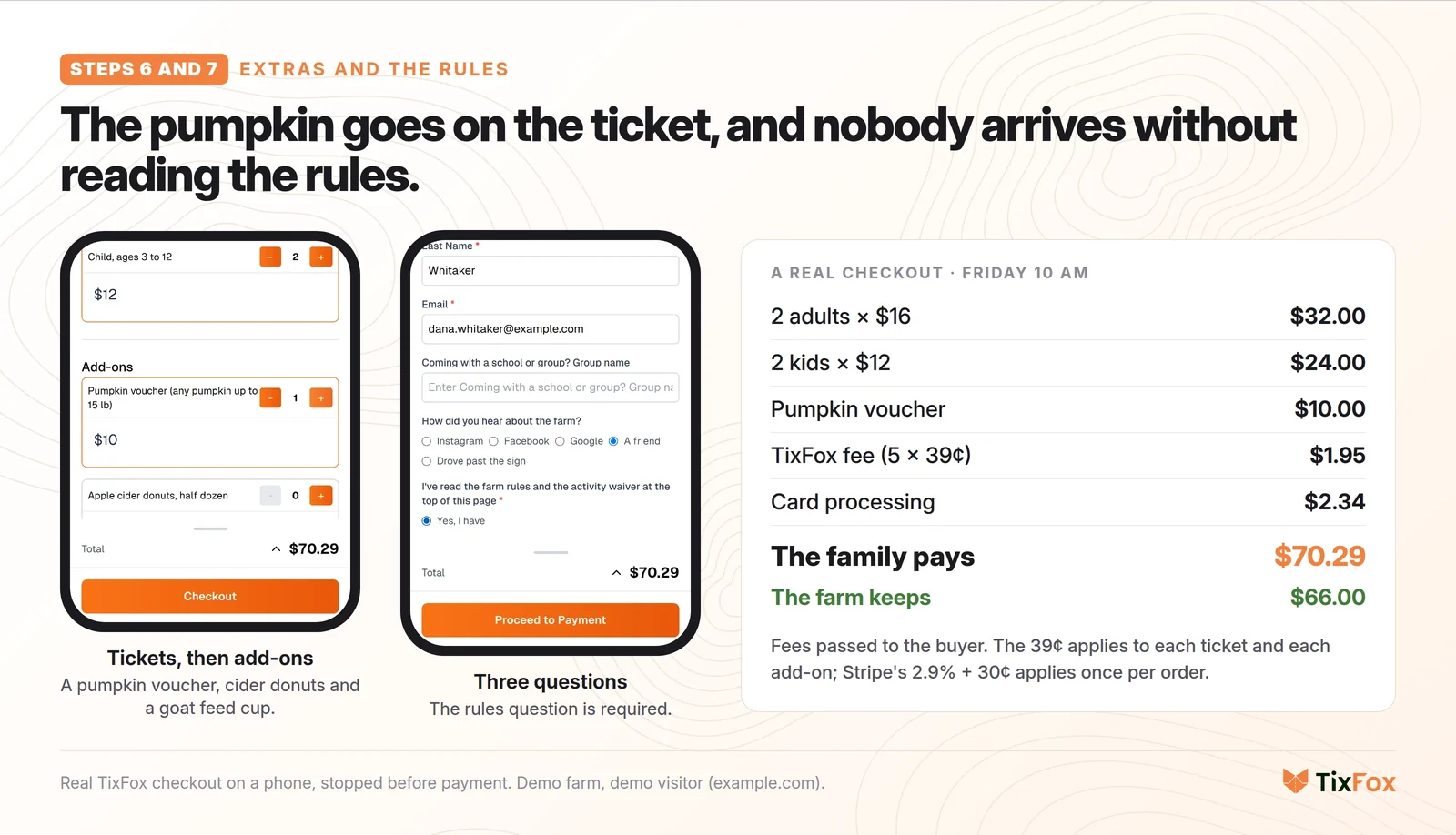
On the demo farm, three add-ons sit under the tickets: a pumpkin voucher ($10, any pumpkin up to 15 lb), a half dozen apple cider donuts ($9) and a goat feed cup ($2). Each one has its own stock for every window, so you can cap the donuts at what the kitchen makes.
Here's a real checkout on the demo farm for Friday at 10: two adults at $16, two kids at $12 and a pumpkin voucher. That's $66. With fees passed to the buyer, the TixFox fee is $1.95 (39¢ on each of the four tickets and the voucher) and card processing is $2.34, so the family pays $70.29 and the farm keeps $66. If you'd rather absorb the fees, switch fee handling to absorb and the price they see is the price they pay.
Step 7: Handle the waiver and your state's agritourism sign
This part is easy to skip, and it's the part that matters if someone twists an ankle in the maze. This isn't legal advice, but here's what's worth knowing.
Many states have agritourism laws that limit your liability for the normal risks of a farm, like uneven ground and animals. Many of them only protect you if you follow their rules exactly, often including a posted warning sign. The National Agricultural Law Center keeps the text of each state's law. Two examples:
- Tennessee wants a warning sign at the entrance and at each activity, in black letters at least one inch tall, and the same warning in any written contract.
- Pennsylvania wants a sign at least three feet by two feet that starts "WARNING: Read your written agreement or the back of your ticket." Its protection also needs a written agreement signed before the activity, in a separate document, in at least 10-point bold type, with wording set by law.
So a checkbox at checkout is not, on its own, the signed agreement Pennsylvania describes. What your tickets can do is make sure every buyer has read your rules and your waiver before they arrive. On the demo farm, a required checkout question says "I've read the farm rules and the activity waiver at the top of this page". Put the same link in your order confirmation email, which you can edit for each event. Keep your signed waiver (paper or e-sign) if your state or your insurer wants one.
Then call your insurer. A Farm Credit East report gives the simplest advice in this whole guide: tell your carrier exactly which activities you run, ask what's covered, and talk to an attorney who knows agritourism.
Step 8: Keep the gate open for walk-ups
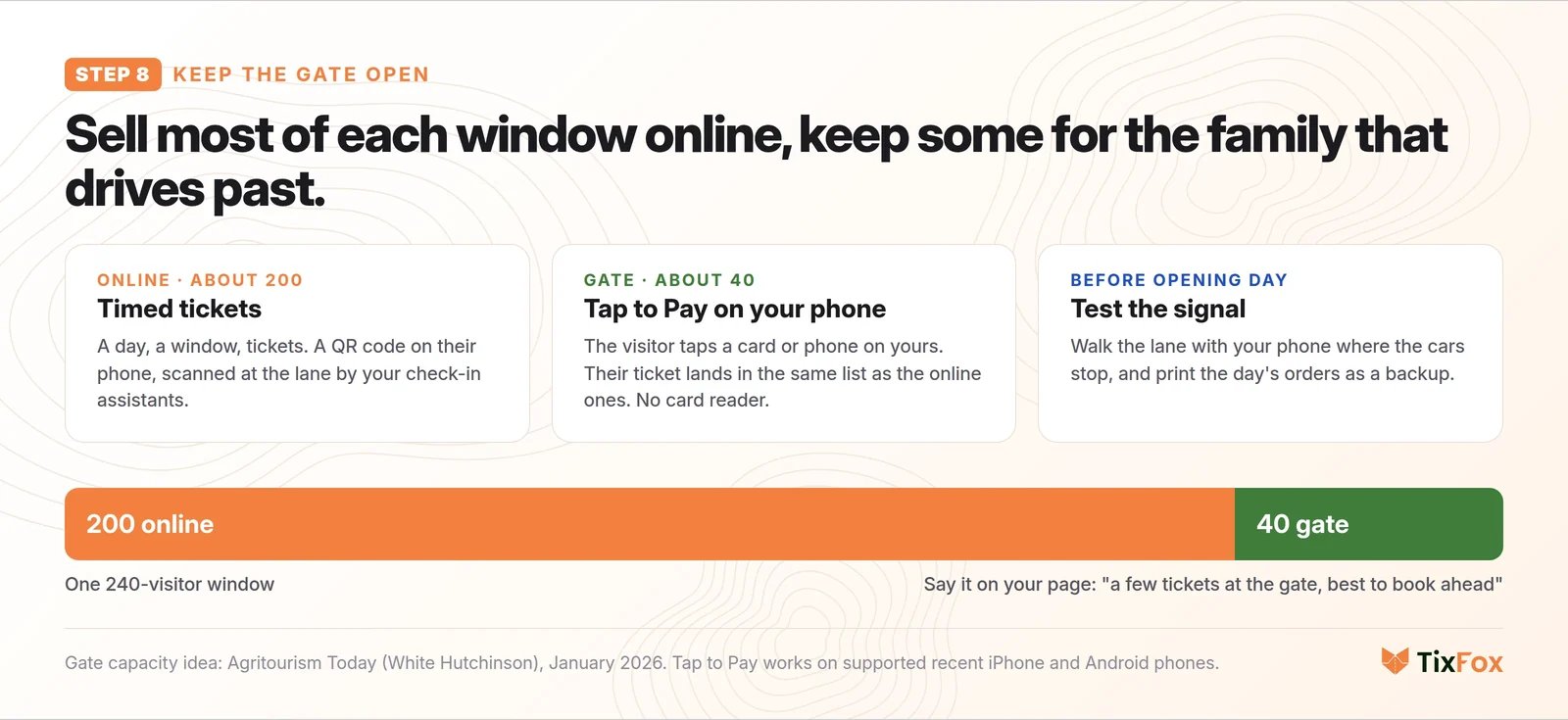
Online-only weekends work for big farms with a waiting list. For most farms, the family that drives past your sign on a sunny Sunday is a customer you want. The Kentucky extension notes that gate sales catch drive-by and last-minute visitors, and Agritourism Today suggests holding back limited same-day capacity and saying so on your page.
In practice:
- Hold back a slice of each window, about 40 of the 240 in our example, and say "a few tickets at the gate, best to book ahead."
- Sell at the gate on your phone. With Tap to Pay in the TixFox app, a visitor taps a card or phone on yours, and their ticket lands in the same list as the online ones. Nothing extra to buy.
- Scan at the lane. The mobile check-in app scans the QR code on each phone. Add your gate staff as check-in assistants so they can scan without seeing your money.
- Test the signal where the cars stop. Rural lanes often have weak service. Walk the lane with your phone before opening day, and keep a printed list of the day's orders at the gate just in case.
School groups and field trips
Weekday mornings are often the best business you'll have all season. Run them as their own event with their own price, and lock it with a passcode that you send only to teachers. Turn on invoice attachment so the school office gets a PDF invoice with every order. On the public event, the "Coming with a school or group?" question catches the groups that book the normal way.
What it costs to sell on TixFox
TixFox is free to set up, with no monthly fee. Each paid ticket costs 39¢ (30¢ under $5), and each add-on costs the same 39¢. Stripe charges 2.9% + 30¢ per order, and the money goes to your own Stripe account as you sell. Full details are on the pricing page.
For a sense of scale: on 10,000 tickets at $20, TixFox's fee comes to $3,900. Eventbrite's US fee of 3.7% + $1.79 per ticket comes to $25,300, per its pricing page. Card processing comes on top on both.
Mistakes that cost farms visitors
- A ticket page that hides what's included. Put the list at the top.
- Caps based on the field instead of the parking lot. The lot fills first.
- The same price every day. The weekend sells out and Tuesday stays empty.
- No weather rule until it rains. Write it before the first sale.
- Too many questions at checkout. Three is plenty: a group name, how they heard about you, and the rules.
- Online-only with no warning. If the gate is closed, say it in big letters, everywhere.
- Trusting the cell signal at the gate. Test it, and print a backup list.
FAQ
How much do pumpkin patch tickets cost?
The farms we checked charge about $19 to $29 per person, with weekends $4 to $9 higher. Bob's Corn in Washington charges $19.95 on weekdays and $28.95 on weekends, and Tanaka Farms in Irvine charges $23 and $27. Pumpkins and food usually cost extra, and the youngest kids often get in free.
Should a farm sell tickets online or at the gate?
Both, for most farms. Online timed tickets spread out the busy weekends and tell you who's coming. Gate sales catch drive-by visitors and last-minute families. Hold back a slice of each window for the gate, and say so on your page.
How long should an arrival window be?
Two hours works for most pumpkin patches and corn mazes. Visitors arrive any time in their window and stay as long as they like. Size each window by parking: spaces × people per car × (window length ÷ average stay).
Is a checkbox at checkout the same as a signed waiver?
Not always. Some states set exact rules. Pennsylvania's protection needs a sign and a separate written agreement signed before the activity, in 10-point bold type. Use the checkout question so everyone reads your rules, keep your signed waiver if you need one, and check with your insurer and an attorney.
What should I do if it rains?
Decide before you sell. Most farms stay open rain or shine and close only for safety. If you close, stop sales for the affected windows, email the visitors, and refund them or move them to another date. Put that rule at the top of your ticket page.
How much does TixFox charge for farm tickets?
39¢ per paid ticket (30¢ under $5) and 39¢ per add-on, plus Stripe's 2.9% + 30¢ per order. No monthly fee. You can pass the fees to the buyer or absorb them.
Ready for the season?
You don't need a big system to sell timed tickets. You need a clear page, sensible caps, a weather rule and a fast gate. Everything in this guide runs on one TixFox event. See it on our agritourism page, or go straight to setting up your weekends.
Start your farm's season: create a free TixFox account, generate your dates and windows, and share one link. Free to set up, 39¢ a ticket.
Sources
- USDA Economic Research Service, 2022 Census of Agriculture: The majority of U.S. counties generate some agritourism income (December 2024).
- Savannah L. Columbia, Advanced or On-Site Ticketing Considerations for Agritourism Operations, Center for Crop Diversification, University of Kentucky (October 2025).
- Complicated ticketing is a turnoff to attendance, Agritourism Today, White Hutchinson Leisure & Learning Group (January 2026).
- Bob's Corn & Pumpkin Festival, admission info (2026 prices).
- NBC Los Angeles, Tanaka Farms pumpkin patch tickets (2026).
- The National Agricultural Law Center, States' Agritourism Statutes: Tennessee and Pennsylvania (3 P.S. § 2605).
- Charles F. Gfeller and Anna-Kate M. Munsey, Who Takes The Fall? Liability Limitations for Agritourism Activity Hosts, Farm Credit East (October 2025).
- Eventbrite organizer pricing (US, checked October 2026).
- TixFox dashboard and checkout, demo account, October 17, 2026. Fees from tixfox.co/pricing and a real checkout.
The farm ("Maple Hollow Farm Fall Festival" in Lancaster, PA), its prices and its visitor are demo data. The TixFox screens, the ticket page and the checkout are real. This guide isn't legal advice.
Keep more of every ticket sale.
- 39¢ per ticket, $0 on free events
- No monthly fee, no contract
- Get paid as each sale comes in