
New guide, October 2026. Every TixFox step was checked in the real dashboard on October 20, 2026. This isn't tax advice; check the tax points with your accountant.
Somewhere in the second committee meeting, two questions land on the table at once. "What should we charge for a ticket?" and "Can guests deduct it?" Nobody's quite sure, the caterer's quote is still in someone's inbox, and the gala is seven months away.
This guide answers both, then walks through the rest of planning a fundraising gala: the budget, ticket and table prices, what the IRS asks you to tell guests, the questions to ask at checkout, the fund-a-need, gala night and the thank-yous. It comes with a free printable checklist, real numbers from two 2026 galas, and real screens from TixFox.
Quick answer: Plan a fundraising gala 9 to 12 months ahead. Set a net goal, get a per-guest price from the venue and caterer, and price each ticket as that fair market value plus the amount you're asking guests to give. Tell guests in writing how much of a ticket over $75 is deductible, sell tables and sponsorships early, collect meal choices at checkout, and run a fund-a-need that guests can give to from their phones. Thank everyone within 48 hours.
Free fundraising gala planning checklist (PDF)
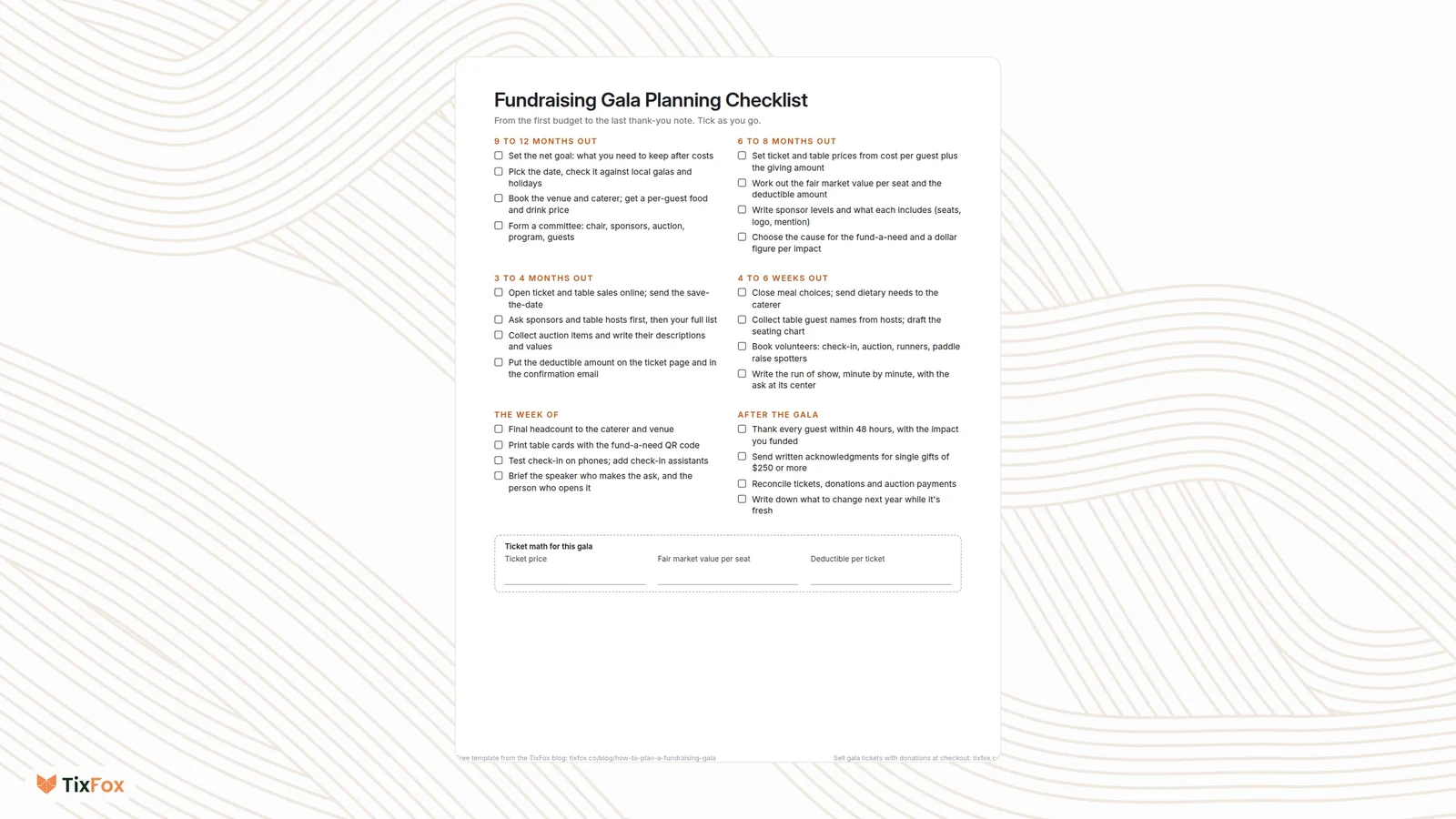
Download the gala planning checklist (PDF): one page, free to print. It runs from 9 to 12 months out to the week after, with a box at the bottom for your own ticket math.
Why galas raise less than they could
Most galas don't fail. They just net less than the room could have given. A few things cause most of it: a ticket priced at the cost of dinner, so the evening only breaks even; a fund-a-need that only people with cash or a pen can join; and guests who aren't sure what they can deduct, so they hold back. Every step below goes after one of those.
Step 1: Set the net goal and the cost per guest
Start with the number you need to keep, not the number you hope to gross. Then get a per-guest price from the venue and caterer: food, drinks, rentals, service and tax. That number is the starting point for two things: your ticket price, and the fair market value you'll tell guests about in Step 3.
Write down the other income too: sponsorships, table sales, the auction and the fund-a-need. If tickets only cover the cost of the night, the giving has to come from those, and that's fine as long as you plan for it.
Step 2: Price tickets and tables
A gala ticket has two parts: what the guest receives (dinner, drinks, the program) and what they're giving. Here's how two real 2026 galas priced it:
- St. Francis Center 2026 Gala (Denver, October 16, 2026): $150 a ticket with a fair market value of $100, so $50 is the deductible portion. A table of 8 is $1,200 ($800 fair market value) and a table of 10 is $1,500 ($1,000). The gala sold out.
- Academy Center of the Arts 2026 Gala (Lynchburg, Virginia, September 19, 2026): $250 per person, with a fair market value of $100 per seat for a seated dinner, full bar and live entertainment.
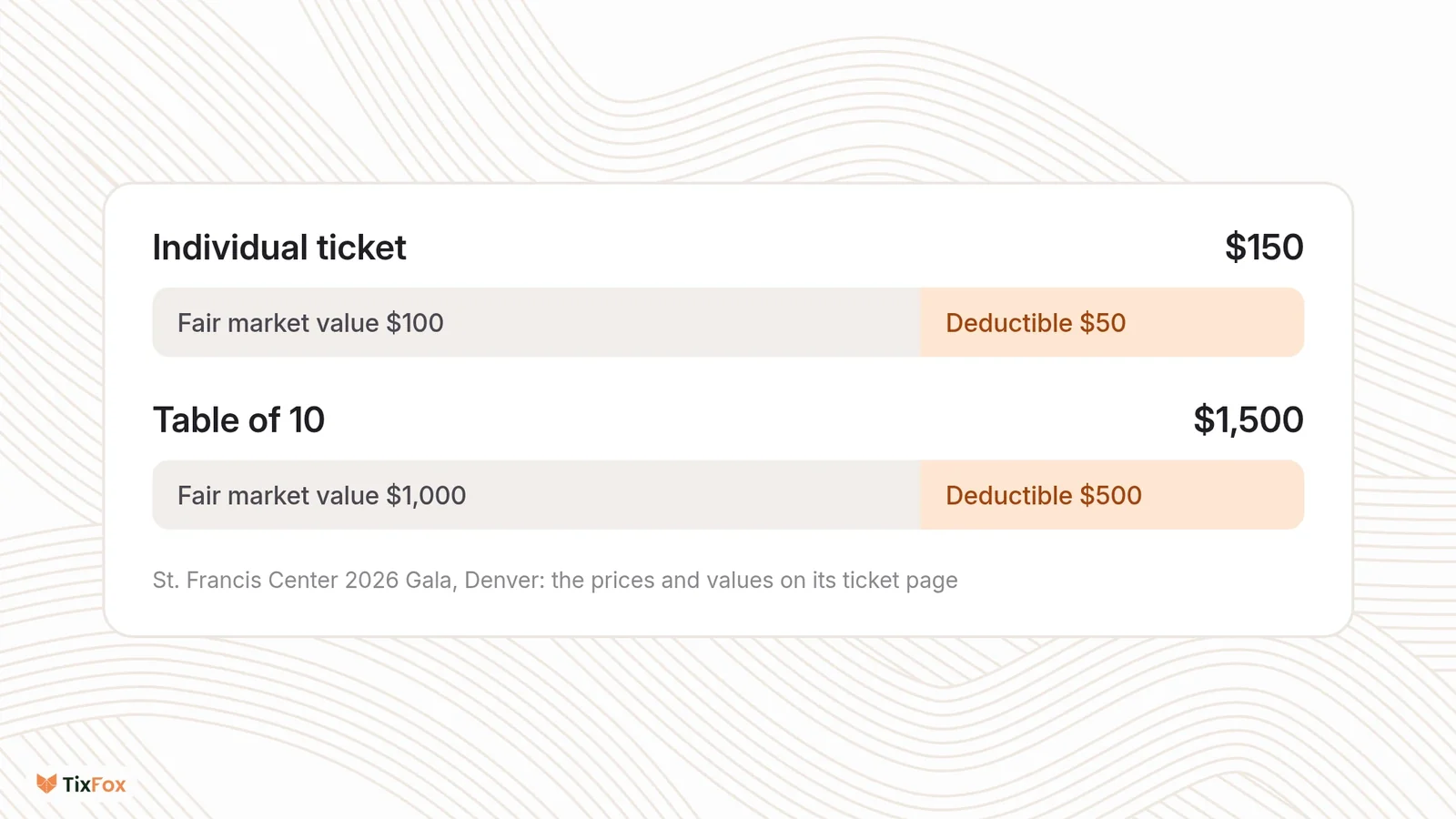
Tables are often priced at the ticket price times the seats, as they are at St. Francis, and sponsorship levels add seats, recognition and a logo on top. Sell tables and sponsorships first: a table host fills ten seats with people you might never reach. Our guide to event sponsorship packages covers how to build the levels.
Step 3: Tell guests what's deductible
This is the step most first-time committees miss, and the IRS is specific about it. IRS Publication 1771 says that when a donor pays more than $75 and gets goods or services back, like a dinner, the charity must give a written disclosure that:
- tells the donor that only the amount above the value of what they received is deductible, and
- gives a good-faith estimate of the fair market value of what they received.
The IRS's own example is a $100 concert ticket with a fair market value of $40: the donor can deduct up to $60, and the charity must give the disclosure because the payment is over $75. The penalty for skipping it is $10 per contribution, up to $5,000 per fundraising event. Separately, a donor needs a written acknowledgment from you to deduct any single gift of $250 or more. Fair market value is what the evening would cost to buy, not what it cost you, so base it on what a comparable dinner and program would cost elsewhere.
In TixFox you can put the disclosure in two places, so every guest sees it before and after they pay:
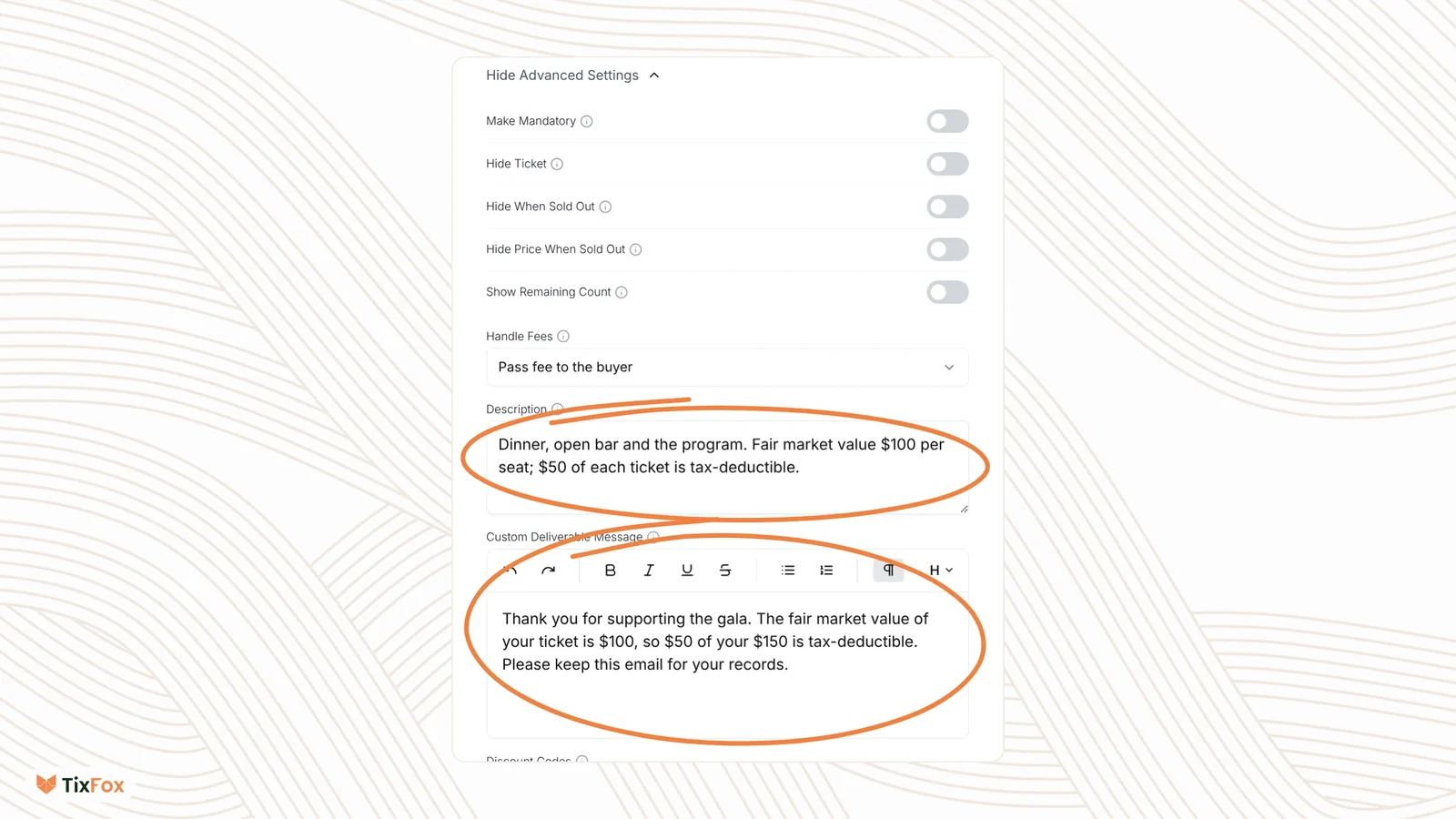
- In the ticket type's Description, under Show Advanced Settings. It shows next to the ticket on your event page.
- In the ticket type's Custom Deliverable Message, which is sent to buyers of that ticket in the confirmation email. Write the fair market value and the deductible amount there, and ask guests to keep the email.
Check the wording, the fair market value and your acknowledgment letters with your accountant.
Step 4: Set up tickets and tables
Open your event in TixFox, go to Ticket Types and click Create Ticket for each:
- Individual ticket: the price ($150), Max Tickets Per Order of up to 10 so a couple or a group can buy together, and the number of seats.
- Table of 10: the table price ($1,500), Max Tickets Per Order of 1, and Quantity set to the number of tables you can seat.
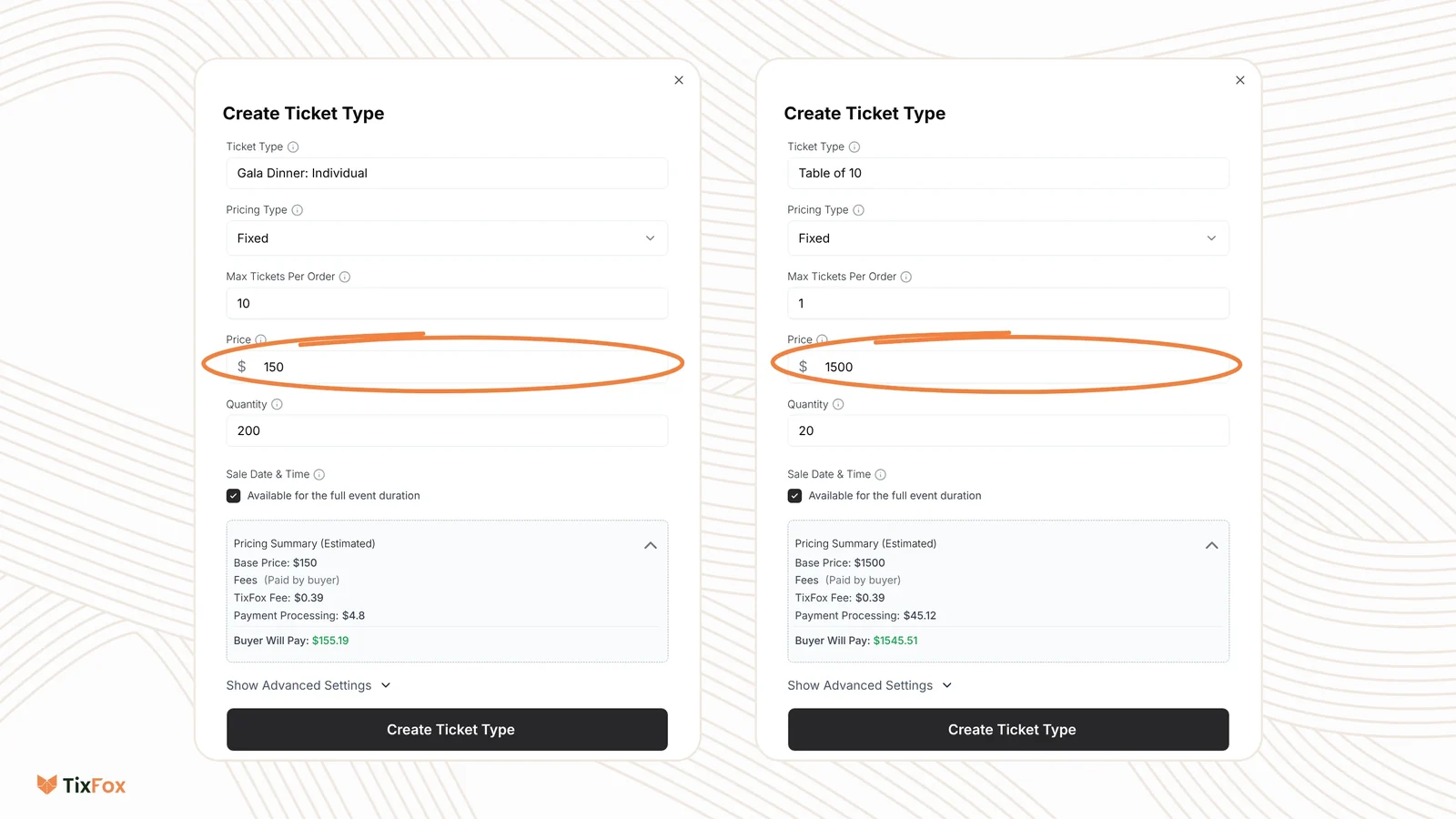
TixFox's fee is $0.39 on the $150 ticket and $0.39 on the $1,500 table, because it's a flat fee per ticket, not a percentage. For sponsor packages, turn on Hide Ticket in the advanced settings and send each sponsor an access code that reveals their package (how hidden tickets and access codes work).
Step 5: Ask for meal choices and table guests at checkout
Under Custom Fields, add the questions the caterer and the seating chart need:
- Meal choice, as a required dropdown.
- Dietary needs or allergies, as a text field.
- Names of your table guests, as a text area, so table hosts can list their nine guests.
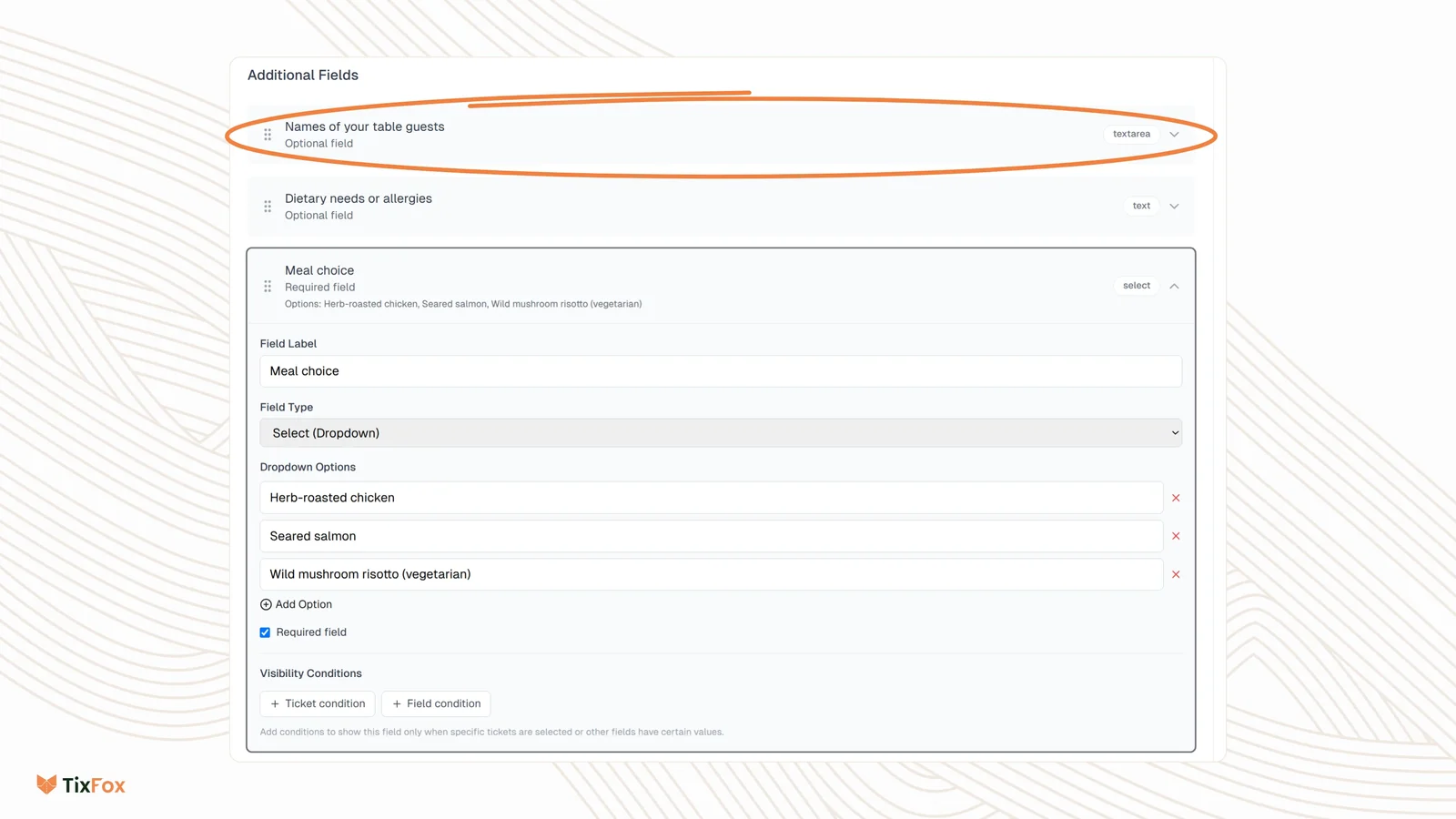
Use Visibility Conditions, then Ticket condition, to show the guest names question only to table buyers. Answers land in each order and in the CSV export, which is your seating chart's starting point.
Step 6: Run the fund-a-need from every guest's phone
The paddle raise or fund-a-need can be the biggest money of the night, and it's the hardest to collect. Turn on Donations under Checkout Settings:
- Give it a Title and a Description that names the impact, like "$500 covers one week of camp for one child".
- Choose Standalone allowed, so people can give without buying a ticket, including supporters who can't come.
- Add Suggested amounts that match your levels, like $100, $250, $500 and $1,000.
- Write a Thank-you message for the confirmation page and email.
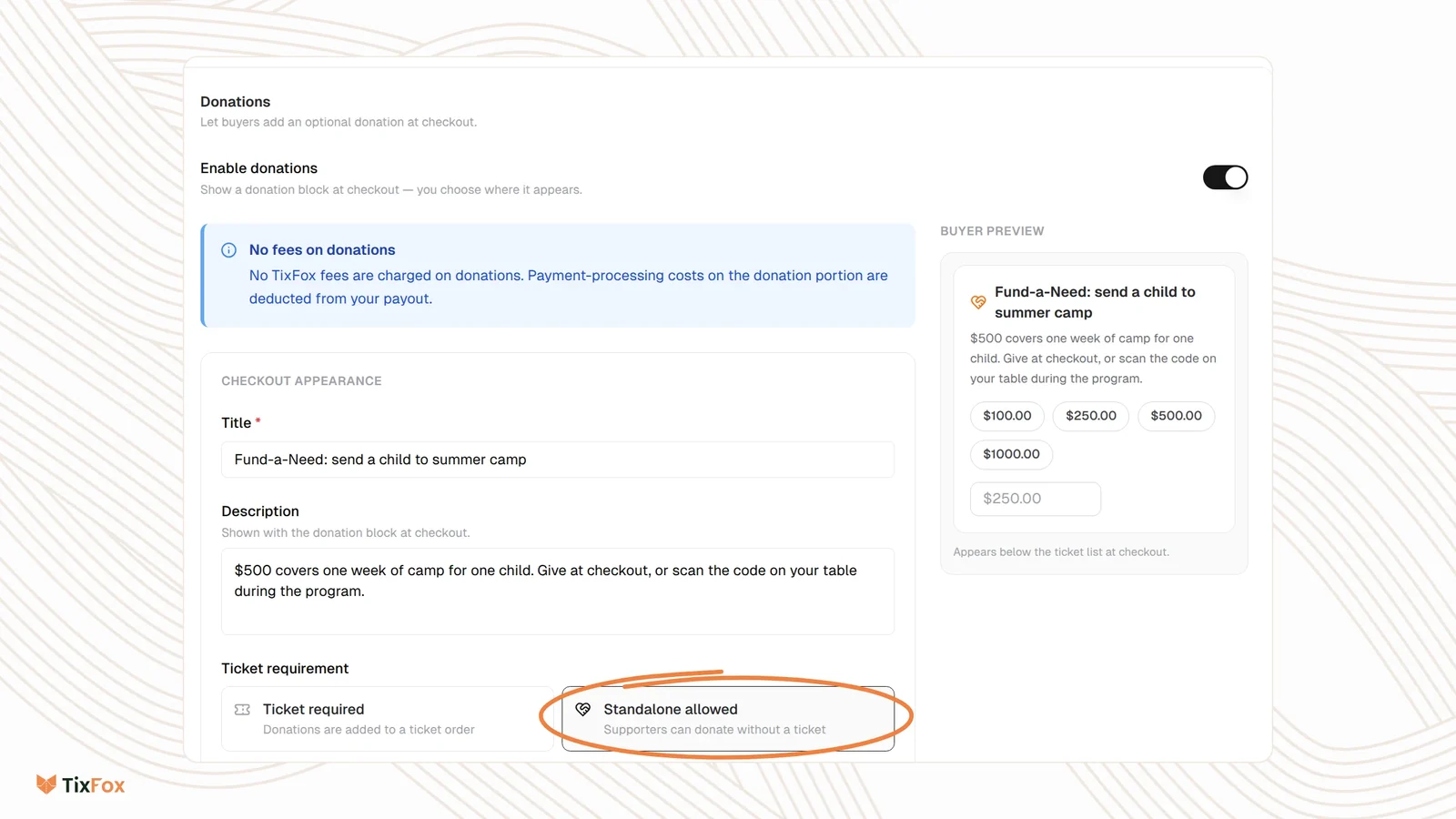
Then print your event's QR code on every table card (sharing your event link and QR code). When the auctioneer calls the levels, guests scan, tap an amount and pay by card in a few taps, and you don't chase pledges for a month. TixFox charges no fee on donations; card processing on the donation is taken from your payout (donations).
Step 7: Gala night and the week after
- Check-in: scan each guest's ticket at the door with the TixFox app, and add volunteers as check-in assistants who can scan for your gala and nothing else.
- Seating: export the orders the week before, sort by table host, and build the seating chart from the guest names.
- Thank-yous: thank every guest within 48 hours with what their gifts funded, and send written acknowledgments for single gifts of $250 or more.
- Refunds: if a guest cancels, TixFox asks whether to refund the donation too or keep it, so you can refund a ticket and keep a gift (refunds).
What gala ticketing costs
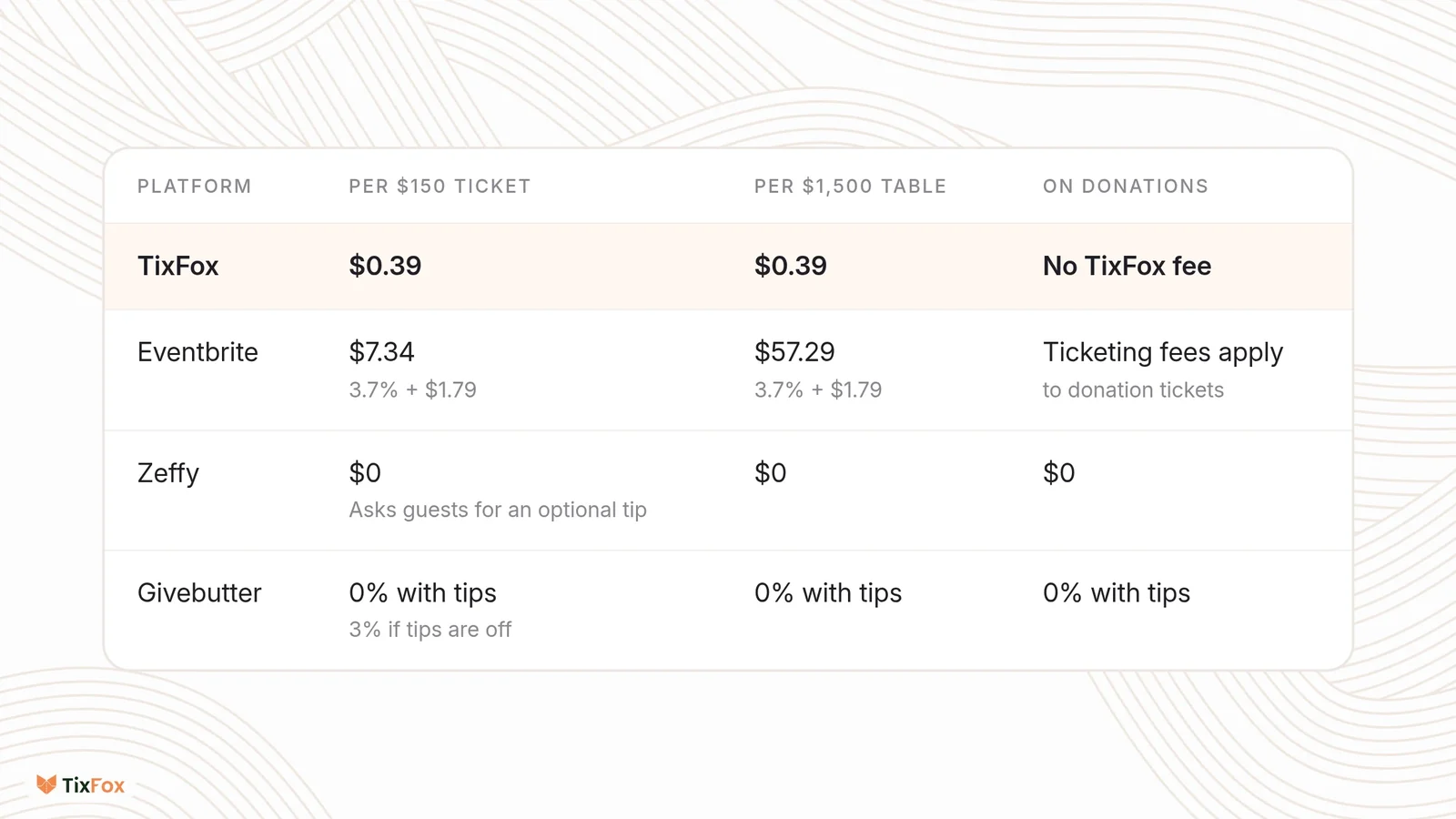
TixFox is free to set up and charges $0.39 per paid ticket, nothing on donations, plus Stripe's card processing of 2.9% + 30¢. On a gala with 200 tickets at $150 and 10 tables at $1,500, that's $81.90 in TixFox fees for the night, which you can pass on to guests or absorb. See TixFox pricing.
Planning a gala this season? Create your gala on TixFox and set up your tickets, tables and fund-a-need today. Free to set up, 39¢ a ticket, no fee on donations.
TixFox, Zeffy, Givebutter or Eventbrite?
Zeffy is free for nonprofits and is paid for by optional tips it asks your guests for at checkout. Givebutter charges no platform fee when tips are on, and 3% plus processing when you turn tips off. Both are built for nonprofits and worth a look, especially for donation forms and campaigns. The trade-off is that your guests see a request to tip the platform on the same page as your ask.
Eventbrite charges 3.7% + $1.79 per ticket in the US, which is $57.29 on a $1,500 table, and its ticketing fees also apply to donation tickets.
TixFox charges a flat 39¢ per ticket however big the price, nothing on donations, and doesn't ask your guests to tip TixFox. It doesn't run auctions, so if you have a silent auction, use your auction tool alongside it.
Mistakes that cost galas money
- Pricing the ticket at the cost of dinner. Then the night only breaks even. Price in the giving.
- No fair market value on the ticket. Guests ask, and the IRS expects the disclosure on payments over $75. Put it on the ticket and in the email.
- A fund-a-need with paper pledge cards only. Give people a QR code and a way to pay on the spot.
- Selling individual tickets before tables. Table hosts and sponsors fill rooms. Ask them first.
- Meal choices by email the week before. Ask at checkout, and the caterer gets one export.
- Thank-yous a month later. Within 48 hours, with the impact in numbers.
How we tested this
We set up a sample gala in TixFox's real dashboard on October 20, 2026, using our demo account: a $150 individual ticket and a $1,500 table of 10, a ticket description and confirmation message with the fair market value, three checkout questions, and a fund-a-need donation block with suggested amounts. The screenshots show those forms filled in. We didn't publish the gala.
The ticket prices and fair market values come from the two galas' own pages, the tax rules from IRS Publication 1771, and platform prices from each company's pricing page on October 20, 2026.
FAQ
Are fundraising gala tickets tax deductible?
Only the part above the fair market value of what the guest receives. If a ticket costs $150 and dinner, drinks and the program are worth $100, up to $50 may be deductible. For payments over $75, the charity must tell guests the deductible amount in writing. Check your situation with your accountant.
How much should gala tickets cost?
Start from your cost per guest, then add the amount you're asking each guest to give. The St. Francis Center's 2026 gala in Denver charged $150 with a $100 fair market value, and the Academy Center of the Arts in Virginia charged $250 with a $100 fair market value. Tables are often the ticket price times the seats.
How do you calculate fair market value for a gala ticket?
Use what a comparable dinner, drinks and entertainment would cost to buy, not what the evening cost the charity. A venue or caterer's per-guest price for a similar event is a good starting point. Put your good-faith estimate on the ticket and in the confirmation email.
How far in advance should you plan a fundraising gala?
Nine to twelve months for most galas. Book the venue and caterer first, set prices and sponsor levels six to eight months out, and open ticket sales three to four months before the night.
What is a fund-a-need at a gala?
A live appeal where guests give at set levels toward one clear cause, like "$500 sends a child to camp for a week", with no auction item in return. Make it easy to join by putting a QR code to a donation page on every table.
Is there a free fundraising gala checklist?
Yes. This guide has a free one-page fundraising gala planning checklist as a printable PDF, from 9 to 12 months out to the week after, with a box for your ticket price, fair market value and deductible amount.
Plan the gala, then let the tickets do the paperwork
The room, the speaker and the ask are yours. Put the tickets, the tables, the disclosure, the meal choices and the fund-a-need on one event page, and the night's money arrives with the details already attached.
Create your gala on TixFox. It's free to set up, tickets cost 39¢ each, and donations have no TixFox fee.
Sources
- IRS Publication 1771, Charitable Contributions: Substantiation and Disclosure Requirements (Rev. 11-2023): the $75 quid pro quo disclosure, the $100 ticket with a $40 value example, the $10 per contribution penalty up to $5,000 per event, the $250 written acknowledgment.
- St. Francis Center 2026 Gala tickets: October 16, 2026, Denver; $150 ticket ($100 fair market value, $50 deductible), tables of 8 and 10.
- Academy Center of the Arts 2026 Gala: The Next Act: September 19, 2026, Lynchburg, Virginia; $250 per person, fair market value $100 per seat.
- Zeffy pricing, Givebutter pricing, Eventbrite pricing and Eventbrite on donations, checked October 20, 2026.
- TixFox dashboard, demo account, October 20, 2026: Create Ticket Type (Max Tickets Per Order, Quantity, Pricing Summary, Description, Custom Deliverable Message, Hide Ticket), Custom Fields and Visibility Conditions, Donations (Standalone allowed, Suggested amounts, Thank-you message, "No TixFox fees are charged on donations"). Fees from tixfox.co/pricing.
Written by the TixFox team. We build ticketing for organizers of every size, and we set up every TixFox step in this guide ourselves.
Keep more of every ticket sale.
- 39¢ per ticket, $0 on free events
- No monthly fee, no contract
- Get paid as each sale comes in